


 73 / 352

Ophiolitic and Basal units and a frontal tecton-
ic mélange occur in Galicia, in the Cabo Orte-
gal, Órdenes and Malpica-Tui complexes. They
constitute a huge allochthonous pile thrust over
the Iberian parautochthonous and autochtho-
nous domains, which represent a section of the
Gondwanan margin that escaped continental
subduction during the Variscan cycle (Schistose
Domain of Galicia-Trás-os-Montes and Central
Iberian Zone).
Previous ideas about the final assembly of
Pangea call upon a single-stage collision between
Gondwana and Laurussia in Carboniferous
times. However, the new data regarding the or-
igin and tectonothermal evolution of the alloch-
thonous terranes involved in the Variscan suture
of NW Iberia suggest a more complex and longer
history for the early stages of supercontinent as-
sembly. According to them, the interaction be-
tween the colliding margins started earlier and
lasted longer than previously considered. These
data are consistent with two successive collisional
events separated by the generation of a relatively
ephemeral oceanic basin. The first collision oc-
curred in Early Devonian times (before
c.
400-
390 Ma) and caused deep subduction of a section
of the margin of Gondwana and the generation
of a HP–UHP metamorphic belt (Upper Units
of the Variscan suture). Lateral motion between
Gondwana and Laurussia favored the opening of
a relatively wide pull-apart basin at
c.
400-395Ma.
The rapid closure of this basin started at
c.
380
Ma and caused the accretion of buoyant oceanic
lithosphere of Devonian age below the northern
continent. This oceanic lithosphere is represented
by the most common ophiolites found in the Va-
riscan Belt (Upper Ophiolitic Units). Mafic slices
with a similar age and showing greenschist facies
recrystallization were accreted later, followed by
mafic complexes with Cambrian age generated
by the activity of peri-Gondwanan volcanic arcs
57
3. GEOLOGICAL FRAMEWORK
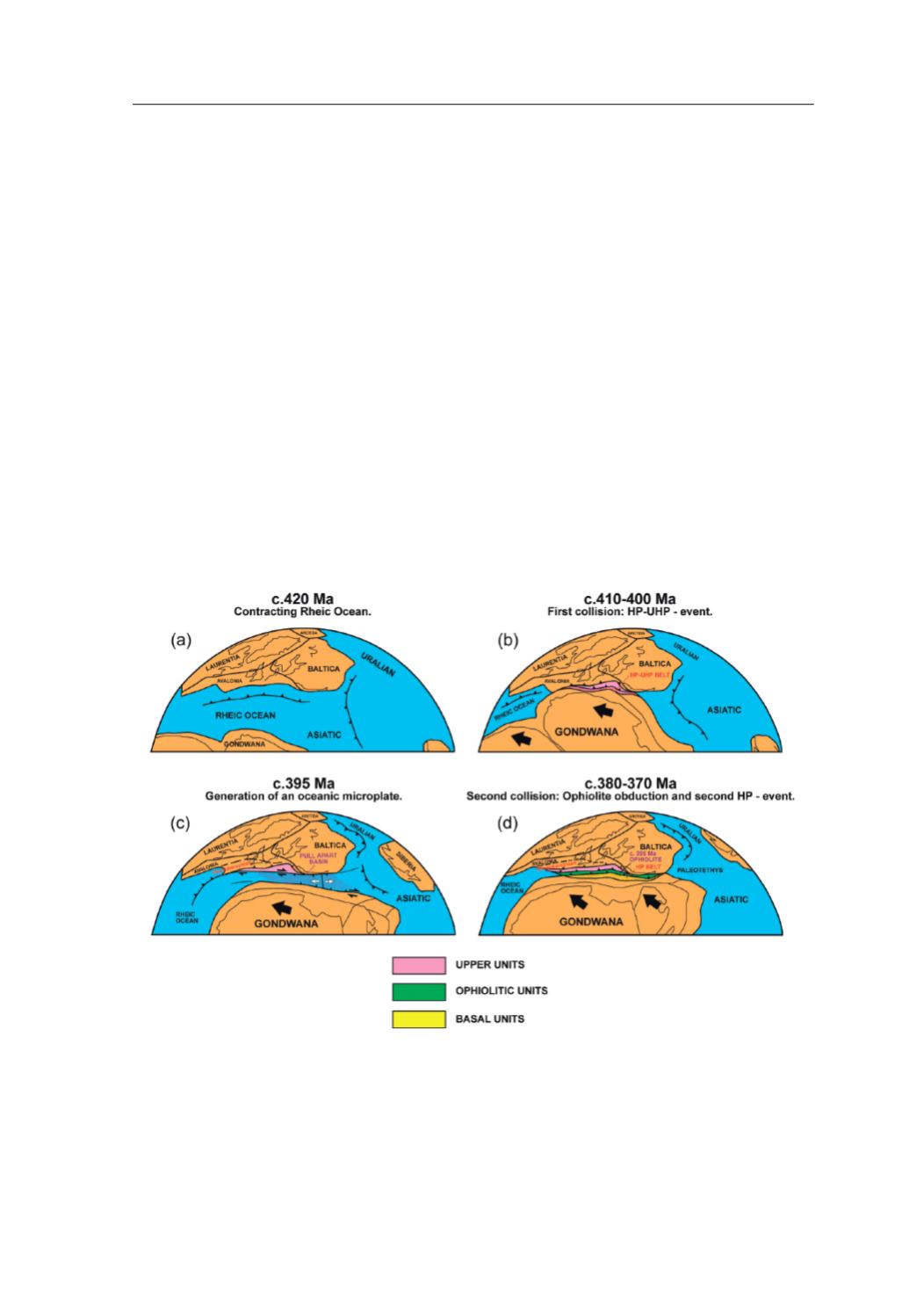
Fig. 29.
(
a
) Reconstruction of the Rheic Ocean realm at the Silurian-Devonian boundary, and (
b
) the initial collision
between Gondwana and Laurussia at
c.
410-400 Ma following the complete closure of the Rheic Ocean. This collision
caused subduction of a section of the margin of Gondwana and generated the HP-UHP metamorphic belt preserved in the
allochthonous Upper Units exposed in the Variscan suture. The true Rheic Ocean suture is not represented in NW Iberia.
(
c
) Dextral motion between Gondwana and Laurussia favored the opening of a rather ephemeral pull-apart basin at
c
. 395
Ma, accompanied by generation of new oceanic lithosphere. (
d
) The second and final collision at
c
. 380-370 Ma caused the
accretion of buoyant oceanic lithosphere followed by new contnental subduction affecting the margin of Gondwana, thereby
developing a second HP-LIT metamorphic belt. The two different HP belts and the ophiolitic units dated at
c
. 395 Ma can be
identified in the allochthonous terranes that outline the Variscan Belt from Iberia to the Bohemian Massif.