


 140 / 352

6. PROVENANCE OF THE HP-HT UPPER ALLOCHTHON
124
WAC sediments and
c.
560
–
510 Ma arc-derived sedi-
ments.
Implications for the Devonian subduction recorded in the
Upper Allochthon
The metasedimentary sequences that constitute the
gneissic units of the Upper Allochthon, both in the
IP upper units (Cari
~
no Gneisses) and in the HP
–
HT
upper units (Banded Gneisses) have the same detrital
sources and they seem to have been deposited in a
same back-arc basin. Therefore, these units were
probably the members of the same sedimentary suc-
cession. Between the time of deposition (
c.
512
–
506 Ma) and high-grade metamorphism (
c.
400
–
390 Ma), both formations constituted a part of the
margin of Gondwana. According to the sedimentary
and igneous processes recorded in this margin, it
changed from a volcanic arc to a passive margin set-
ting at around the Cambrian
–
Ordovician boundary,
after a short event of extension marked by the intru-
sion of alkaline
–
peralkaline igneous rocks (Rodrıguez
Aller, 2005; Abati
et al.
, 2010; Dıez Fernandez
et al.
,
2012a).
The different metamorphic conditions reached by
both units indicate that the HP
–
HT member of the
Upper Allochthon was affected by subduction at
c.
400
–
390 Ma. This deep subduction affecting the mar-
gin of Gondwana is considered a clear evidence for a
first collision between this continent and the southern
margin of Laurussia (Arenas
et al.
, 2014a). Different
structures and metamorphic recrystallizations related
to this collision have also been described in the IP
upper units. In this case, the intensity of deformation
was much lower and only limited shear zones and
amphibolite facies Barrovian metamorphism were
generated (Gomez Barreiro
et al.
, 2006; Arenas
et al.
,
in press). The differentiated tectonothermal evolution
recorded in the Cari
~
no and Banded gneiss forma-
tions, could have been favoured by the previous
structure of the Gondwana margin, achieved during
the Cambrian
–
Ordovician extension. It has been pub-
lished (Dıez Fernandez
et al.
, 2014), that in the Cam-
brian
–
Ordovician transition, lithospheric extension
induced crustal necking and stretching, compartment-
ing the Gondwana lithosphere into several continen-
tal microblocks. During the Devonian collision the
thicker sections of the margin were affected by lim-
ited accretion and thickening, developing Barrovian
metamorphism. The adjacent thinned sections experi-
enced profound subduction directed to the North,
favoured by zones of inherited crustal weakness,
developing the HP
–
HT subduction-related metamor-
phic conditions of the Banded Gneiss formation and
its HP
–
HT equivalents along the Variscan belt
(Fig. 11b,c).
According to previously published structural data
of the Banded Gneiss formation, subduction affecting
the entire lower section of the Upper Allochthon was
probably oblique with a top-to-the-NNE sense of
shearing (present day coordinates; Abalos
et al.
,
2003, 2011). At first, this sense of movement is not
(a)
Long livedmagmatic arc
(c. 750-500Ma)
Ediacaran -Cambrian
peri-Gondwananseries
Neoproterozoicorogens
Cratonsandmeta-cratons
Active long lived subduction zone
Back-arc basin
c. 500 Ma
Avalonian -CadomianMagmaticArc
0.54-1.1
1.8-2.2
2.7-2.9
3.1-3.4
Ga
0.54-1.2
1.6-2.3
2.6-2.8
3.0-3.3
Ga
0.54-0.7
1.0-1.35
1.45-1.75
2.5-3.1
Ga
0.55-0.65
0.9-1.1
1.65-1.85
2.45-2.7
Ga
0.55-0.65
0.9-1.1
1.65-1.85
2.45-2.7
Ga
Zirconages from
the cratons
Upperunits inNW Iberia
Basalunits inNW Iberia
Autochthon inNW Iberia
Amazonian
Craton
West
African
Craton
Sahara
Meta-Craton
Congo
Craton
Kalahari
Craton
Arabian
Nubian
Shield
Indian
Shield
EastAntartic
Shield
Australian
Shield
Iapetus - Tornquist Ocean
South Pole
c.
420 Ma
Contracting Rheic Ocean.
BALTICA
ASIATIC
GONDWANA
RHEICOCEAN
(b)
c.
410–400 Ma
First collision: HP-UHP - event.
GONDWANA
BALTICA
ASIATIC
HP-UHPBELT
UPPERUNITS
(c)
HP
IP
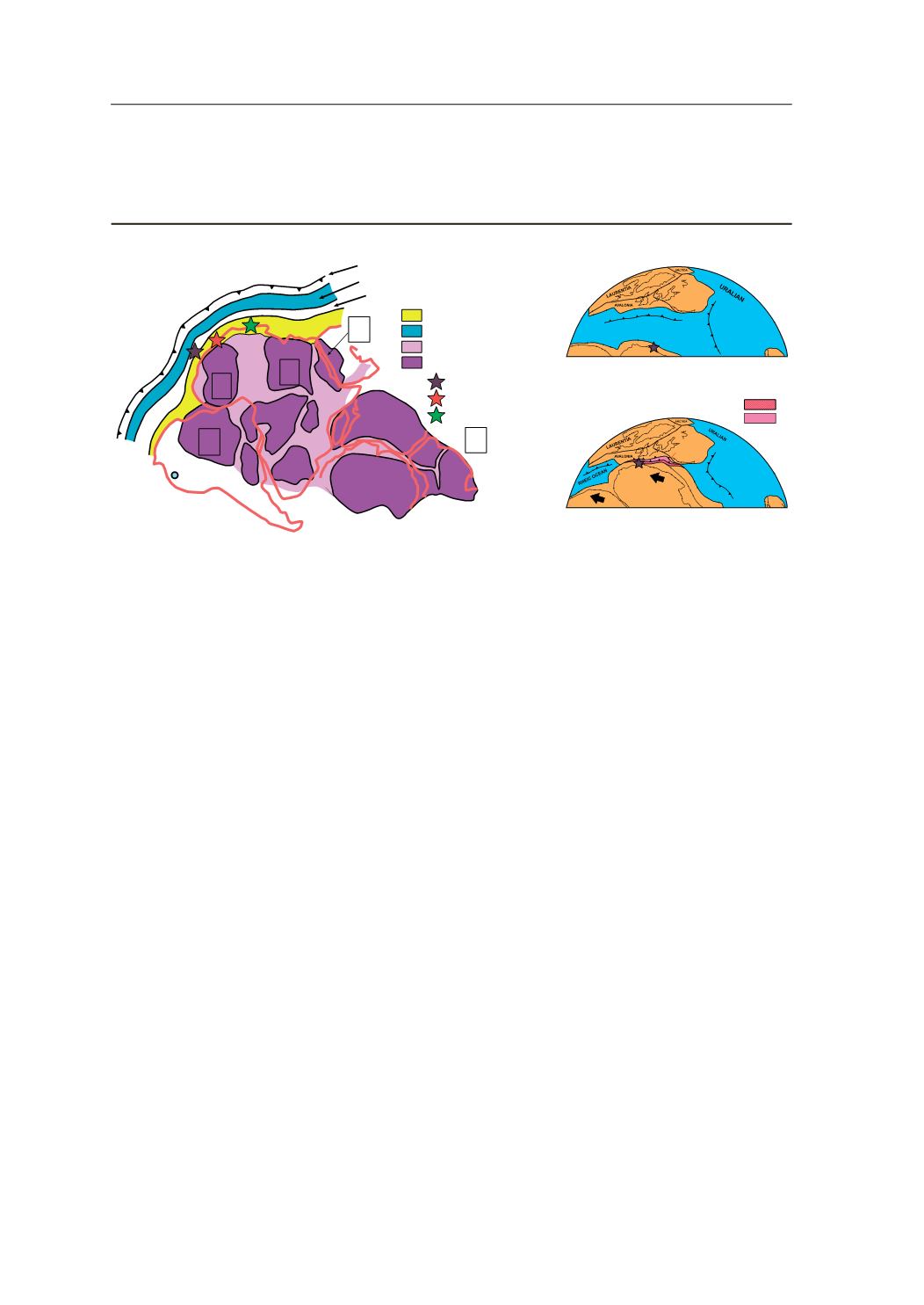
Fig. 11.
(a) Sketch showing the proposed paleogeographic position of the upper units (Upper Allochthon) and other terranes from
the NW Iberian Massif at
c.
500 Ma. Simplified paleogeography of Gondwana based on Fernandez-Suarez
et al.
(2013). Numbers
in squares are zircon ages in Ga from the cratons, from Linnemann
et al.
(2014) and references therein. New zircon ages have been
added to the West African Craton (Avigad
et al.
, 2012) and to the Arabian Nubian Shield (Morag
et al.
, 2012). (b & c) Sketch
showing the proposed paleogeographic position of the upper units (Upper Allochthon) during the Devonian collision (based on
Arenas
et al.
, 2014a).
©
2015 John Wiley & Sons Ltd
974
R. ALBERT
ET AL.