


 135 / 352

6. PROVENANCE OF THE HP-HT UPPER ALLOCHTHON
119
(7.9%), 43 are Paleoproterozoic (37.7%) and 8 are
Archean (7%). MDA
24
calculated for this sample,
using eight ages (see above), is 520.9 6.7 Ma.
Analyses from all samples are summarized in Figs
5 and 6, and add a total of 729 age determinations,
of which 613 were concordant (
<
10
%
discordance, d
=
15.9
%
). Of the analyses, 34.7% (
n
=
213) have a
Palaeozoic
–
Neoproterozoic age with peaks at
c.
512,
522, 545, 561, 575, maximum abundance at 522
–
512 Ma, and a tail with minor peaks between 780
and 590 Ma. Mesoproterozoic ages are scattered in
the interval age of
c.
1.6
–
1.1 Ga and do not define
any maximum, comprising 2.8% (
n
=
17) of the total
ages. The main age group is Paleoproterozoic
(39.6%,
n
=
243) and the majority of the ages are
constrained between
c.
21.4 and 1.88 Ga with a well-
defined maximum at 2.07 Ga. The Archean popula-
tion represents 22.8% (
n
=
140) of the analyses and
shows two main groups, one with ages concentrated
at 2.52
–
2.48 Ga (maximum at
c.
2.51 Ga), and a
second group ranging 2.68
–
2.61 Ga (maximum at
2.64 Ga).
Maximum depositional ages calculated for each of
the five samples vary from 521 to 497 Ma. This
MDA age spread is relatively high and considering
the high deformation attained by these gneisses, an
MDA average does not seem to be reliable (MSWD
of the average is too high
=
8.6). Therefore, the older
MDA was chosen (
c.
521 Ma) to establish the MDA
for this formation.
Lu
–
Hf results
From the 613 concordant zircon cores analysed
with the U
–
Pb method, 463 were analysed for
Lu
–
Hf isotopes (Tables S6
–
S10). Around 46% of
all analyses have positive
e
Hf
(
t
)
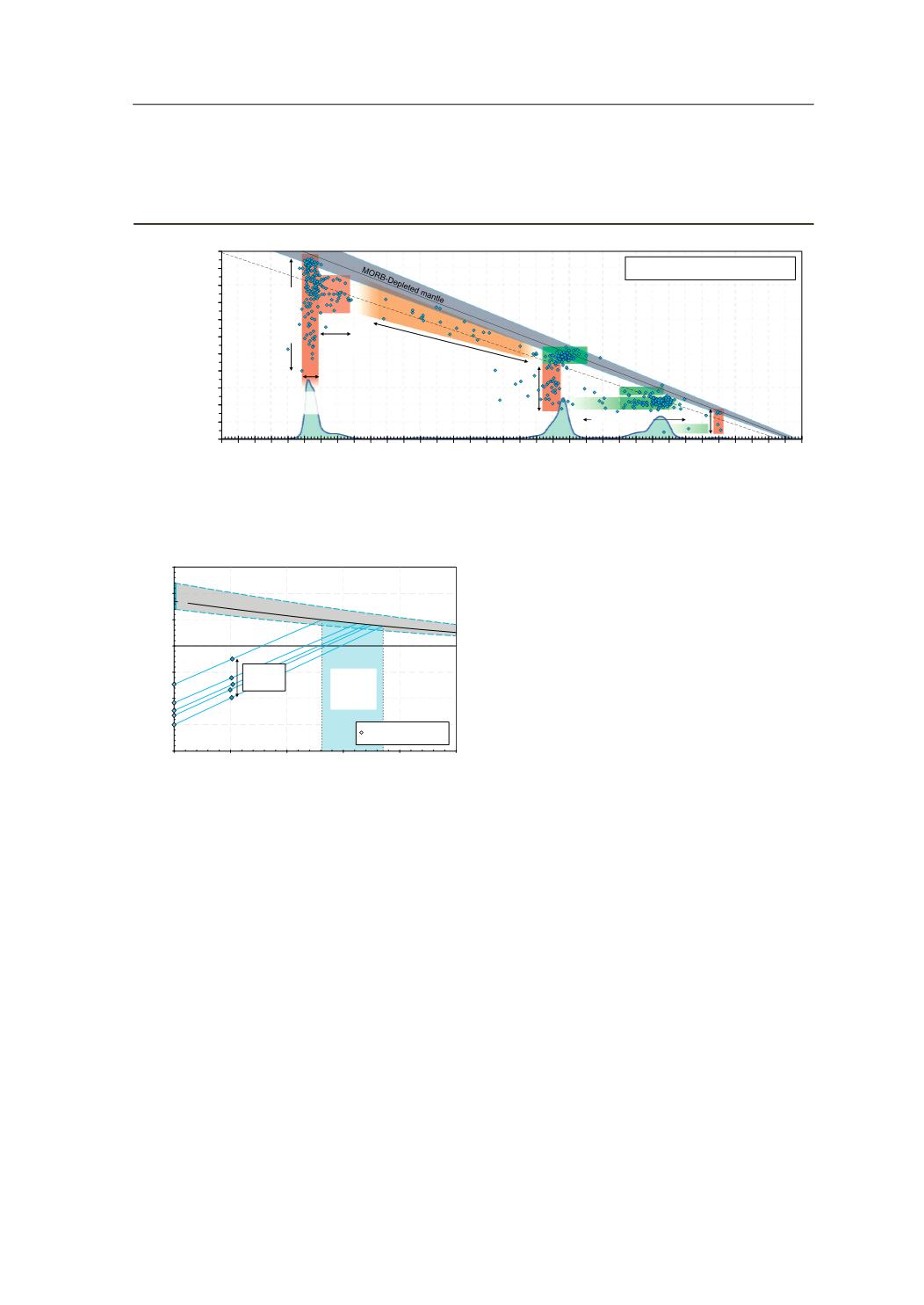
(Fig. 7a). As these
superchondritic zircon data fall in the MORB-de-
pleted mantle field (Fig. 7a), it can be surmised
that the zircon crystallized from magmas that were
almost directly derived from a depleted mantle
source.
Palaeozoic
–
Neoproterozoic zircon is arranged in
the Hf
–
U
–
Pb age diagram in two ways (Figs 7a,b
& 8). First, as a vertical array of zircon with crys-
tallization ages between
c.
590 and 490 Ma, with
e
Hf
(
t
)
values from
+
9.5 to 38, and second, with
ages of
c.
780
–
590 Ma and
e
Hf
(
t
)
values from
+
4
to 10.
A group of zircon values (
n
=
19), which are
mainly Mesoproterozoic (1615
–
978 Ma), plot around
the CHUR evolution trend with
e
Hf
(
t
)
from
+
6.5 to
5.5 (average:
+
1.2).
recycling trend
arc
c.490-590
CHUR
mixing trend
“proto-arc”
590-780
?
0.2806
0.2808
0.2810
0.2812
0.2814
0.2816
0.2818
0.2820
0.2822
0.2824
0.2826
(
176
Hf/
177
Hf)
0
500
1000
1500
2000
2500
3000
[Ma]
HP-HT Upper Allochthon
n
= 463
Fig. 8.
176
Hf/
177
Hf
v.
age plot for detrital zircon data. Horizontal green shaded areas represent recycling trends with
176
Lu/
177
Hf
=
0. Vertical red shaded areas represent mixing between juvenile and recycled crustal material formed in magmatic
arcs. The orange shaded area represents a source that developed through time with a similar
176
Lu/
177
Hf ratio as the CHUR and
depleted mantle, from which the Mesoproterozoic zircon crystallized.
–20
–15
–10
–5
0
5
10
15
0
500
1000
1500
2000
ε Nd
Age (Ma)
T =
DM
1.31 – 1.85
Ga
(
n
= 5)
CHUR
MORB
DM
MaxDep
Ages
εNd(t) =
–2.5 – –9.5
Banded Gneisses,
Cabo Ortegal Complex
Fig. 9.
Sm
–
Nd isotope evolution diagram showing Banded
Gneisses Sm
–
Nd whole
–
rock data. Rhombus show
e
Nd values
at present day and at maximum depositional ages. See text for
discussion and for constants and parameters used. CHUR,
chondritic uniform reservoir; DM, depleted mantle; MORB,
mid ocean ridge basalt.
©
2015 John Wiley & Sons Ltd
PROVENANCE OF THE HP
–
HT VARISCAN TERRANE
969