


 222 / 352

allochthonous terranes are fairly continuous along the suture and largely
comparable throughout the European Variscan belt (
Faryad and Kachlík,
2013; Kroner and Romer, 2013
). Recent isotopic and geochronologic
data on the origin of the Ophiolitic Units and U
–
Pb geochronological
constraints on the HP events provide new insights into the early events
involved in the formation of Pangea. The history of convergence and
collision is probably longer and more complex than previously described.
2. Terranes involved in the Variscan suture
The NW Iberian section of the Variscan belt contains different ter-
ranes with contrasting origins and tectonothermal evolution (
Arenas
et al., 1986; Martínez Catalán et al., 2009
). The Central Iberian Zone
represents the lowest sequence and together with a parautochthonous
domain (or Schistose Domain) de
fi
nes the main section of the
Gondwanan margin involved in the Variscan orogen (
Martínez Catalán
et al., 2009
) (
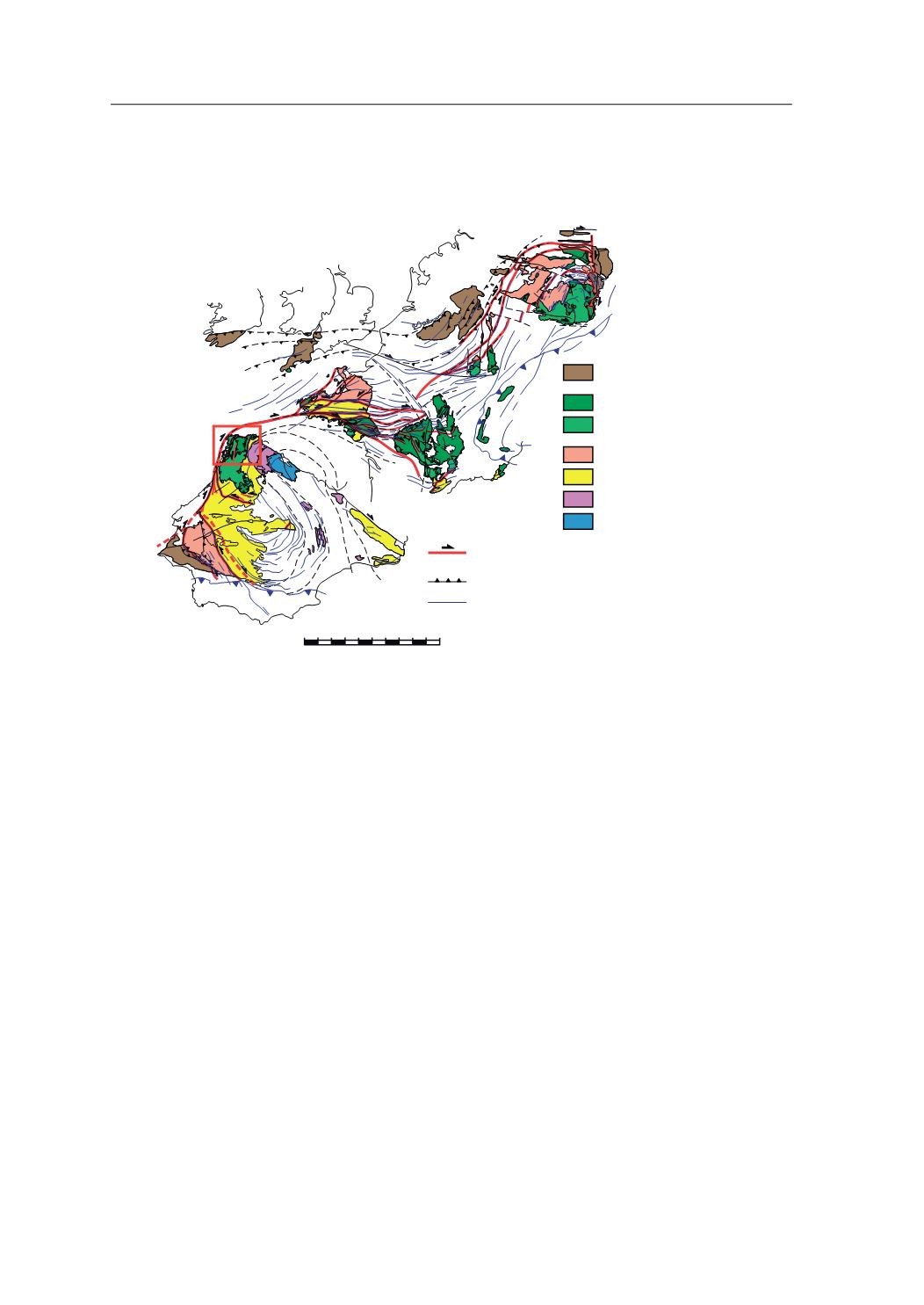
Figs. 1 and 2
). On top, a set of allochthonous terranes of al-
leged exotic nature forms a nappe stack representative of the suture
zone (
Figs. 1 and 2
). Three main groups of terranes have been identi
fi
ed,
two of which show continental crustal af
fi
nities (Basal and Upper Units).
Theseareseparatedbyophiolitesrepresentingthesutureitself(Ophiolitic
Units,
Fig. 2
).
Located immediately below the suture, the Basal Units contain
metasedimentary rocks (comprising a thick pile of metagreywackes
with minor metapelites, graphitic schist, calc-silicate lenses, metacherts
and quartzites), calc-alkaline to alkaline
–
peralkaline metagranitoids,
and some ma
fi
c rocks. Maximum depositional ages for the
metasedimentary series range between Ediacaran and Early Ordovician
(
Díez Fernández et al., 2010, 2013
), with Nd model ages between 1.78
and 2.22 Ga (
Fuenlabrada et al., 2012
). Major and trace element geo-
chemistry of the metagreywackes suggest deposition in association
with a peri-Gondwanan arc system built upon a thinned continental
margin. The calc-alkaline (c. 493 Ma;
Abati et al., 2010
) and alkaline
–
peralkaline (c. 475
–
470 Ma;
Díez Fernández et al., 2012a
) granitoids
were generated within this arc, suggesting an evolution from conver-
gence to continental rifting. The Basal Units are considered to represent
a section of the most external margin of Gondwana located somewhere
between the West African and Saharan cratons (
Díez Fernández et al.,
2010
). The
fi
rst tectonothermal event recorded in these units is a HP
and low- to intermediate-T (LIT) event dated at c. 370 Ma (
Rodríguez
et al., 2003; Abati et al., 2010
). A variety of HP mica schists and
orthogneisses, C-type eclogites and some blueschists were formed at
this time (
Arenas et al., 1995, 1997; Rodríguez et al., 2003; López
Carmona et al., 2013
).
Resting on top of the suture zone, the Upper Units consist of a pile,
10
–
12 km thick, of metasedimentary rocks (mainly metagreywackes),
large massifs of calc-alkaline orthogneisses, and gabbros with composi-
tions of island-arc tholeiites, together with medium to high grade ma
fi
c
rocks, including B-type eclogites (
Coleman et al., 1965
) and HP granu-
lites, and some ultrama
fi
c massifs. The low grade metagreywackes lo-
cated in the uppermost position have a Middle Cambrian maximum
depositional age (
Fernández-Suárez et al., 2003
), with Nd model ages
ranging between 0.72 and 1.22 Ga, and major and trace element
compositions typical of active margin settings (
Fuenlabrada et al.,
2010
). Protolith ages for gabbros and granitoids range between 490
and 520 Ma (
Fernández-Suárez et al., 2007; Andonaegui et al., 2012
).
These units were part of a Cambrian peri-Gondwanan magmatic arc,
and were located west of the external margin section represented by
WALZ
CZ
GTMZ
Z
ST
P
ZSP
J
CIZ
ZS
PL
OMZ
SPZ
Z
SIS
ZSCB
FP
N
CIA
IAA
MCA
BA
Iberian
Massif
Massif
Central
Armorican
Massif
Alpine
Front
Rhenish
Massif
Bohemian
Massif
0
250
500 km
Magnetic lineaments
Variscan strike-slip
Shear zones
Main Variscan thrusts
separating zones
External thrust belt
and foredeep basin
Allochthonous terranes with
ophiolites and high-P rocks
Parautochthon/
Lower allochthon
Gondwanan zones with
strong Cadomian imprint
Gondwanan zones with
Early Ordovician magmatism
Variscan miogeocline fold
and thrust metamorphic belt
Variscan foreland
thrust belt
EUROPEAN VARISCIDES
t
n
o
r
F
eni
p
l
A
Fig. 2
Fig. 1.
Terranes and oroclines of the Variscan belt (
Martínez Catalán, 2011
). Arcs: BA, Bohemian; CIA, Central Iberian; IAA, Ibero-Armorican; MCA, Massif Central. Zones of the Iberian
Massif: CIZ, Central Iberian; CZ, Cantabrian; GTMZ, Galicia-Trás-os-Montes; OMZ, Ossa-Morena; SPZ, South Portuguese; WALZ, West Asturian-Leonese. Shear zones and faults: BCSZ,
Badajoz-Cordoba; JPSZ, Juzbado-Penalva; LPSZ, Los Pedroches; NPF, North Pyrenean; PTSZ, Porto
–
Tomar; SISZ, Southern Iberian. Location of the geological map and section presented
in
Fig. 2
are also shown.
757
R. Arenas et al. / Gondwana Research 25 (2014) 756
–
763
8. TWO STAGE COLLISION
206