


 225 / 352

Hence, the new data from the allochthonous terranes of NW Iberia,
in particular Lu
–
Hf isotope geochemistry of the Devonian ophiolites
and detailed U
–
Pb geochronology of the two HP metamorphic events,
seem to be more consistent with the development of two successive
collision events between Gondwana and Laurussia, each taking place
in a context of oblique convergence and separated in time by the
opening of a rather wide oceanic basin, probably of pull-apart type.
The allochthonous Upper Units are herein interpreted as the most
external part of the Gondwanan margin, a rather wide continental
shelf containing thick turbidite series intruded by large massifs of
gabbros and granitoids. This lithological succession was formed during
the activity of a volcanic arc in Cambrian times, having developed
after an important episode of crustal extension and thinning. This conti-
nentalshelfdidnot witnesssigni
fi
cantnewigneousactivityordeforma-
tion until the onset of the HP
–
UHP metamorphic event, and hence
shows the characteristics of a typical passive margin for most of the
Ordovician and Silurian. In the geological record covering this time
interval there is no evidence suggesting any signi
fi
cant separation of
this continental shelf from the Gondwanan mainland. Convergence be-
tween Gondwana andLaurussia led to a
fi
rst continentalcollisionbefore
400
–
390 Ma, including the dextral subduction (
Ábalos et al., 2003
) of
the most external and thinned part of the Gondwanan margin to the
north accompanied by the
fi
rst HP
–
UHP metamorphism. The southern
margin of Laurussia acted as the upper plate in the subduction complex
and the most important collision probably affected the eastern part of
Avalonia and the Baltic margin (
Fig. 3
).
Renewed dextral motion between Gondwana and Laurussia favored
the rapid generation of a rather wide pull-apart basin in Early Devonian
times, which we interpret as the tectonic setting for the generation of
the c. 395 Ma ma
fi
c rocks forming the most typical ophiolites involved
in the Variscan suture (
Fig. 4
). The pull-apart basin currently being
generated between the North American Plate and the Caribbean Plate
can be considered a modern analog for the suggested tectonic setting,
although in this case the lateral component is sinistral. The Gonâve
microplate occupies the pull-apart basin and comprises oceanic litho-
sphere with a rather thin or completely absent sedimentary cover
(
ten Brink et al., 2002
). This oceanic lithosphere is being generated by
theactivityoftheMid-Cayman SpreadingCentre (
Fig. 5
). Inthismodern
analog, as was probably the case at the beginning of Pangea assembly,
the pull-apart basin was generated following an initial collision that
produced the high-P belts in northern Cuba and Hispaniola (
Fig. 5
)
(
García-Casco et al., 2008; Sommer et al., 2011
).
Continued dextral convergence
fi
nally caused theclosure of thepull-
apart basin and the accretion of buoyant oceanic lithosphere beneath
the northern continent starting at c. 380 Ma (Careón and Purrido
ophiolites;
Dallmeyer et al., 1997
). The accreted oceanic lithosphere is
mostly metamorphosed to the amphibolite facies, but the occasional
presence of corundum-bearing metamorphic soles indicates the local-
ized presence of high thermal gradients (
Díaz García et al., 1999
).
Later accretion of new Devonian ma
fi
c slices took place under
greenschist facies conditions (Moeche Ophiolite), and was followed by
the accretion of ma
fi
c complexes rimming the continental margin that
formed within the Cambrian peri-Gondwanan volcanic arc (Vila de
Cruces Ophiolite). The
fi
nal outcome was the generation of a complex
suture zone that records protracted dextral convergence and is charac-
terized by the presence of a double ophiolitic belt of contrasting origin
c.410-400 Ma
First collision: HP-UHP - event.
GONDWANA
BALTICA
LAURENTIA
AVALONIA
ARCTIDA
URALIAN
ASIATIC
RHEICOCEAN
HP-UHPBELT
c.420 Ma
Contracting Rheic Ocean.
BALTICA
LAURENTIA
AVALONIA
ARCTIDA
URALIAN
ASIATIC
GONDWANA
RHEIC OCEAN
UPPER UNITS
(a)
(b)
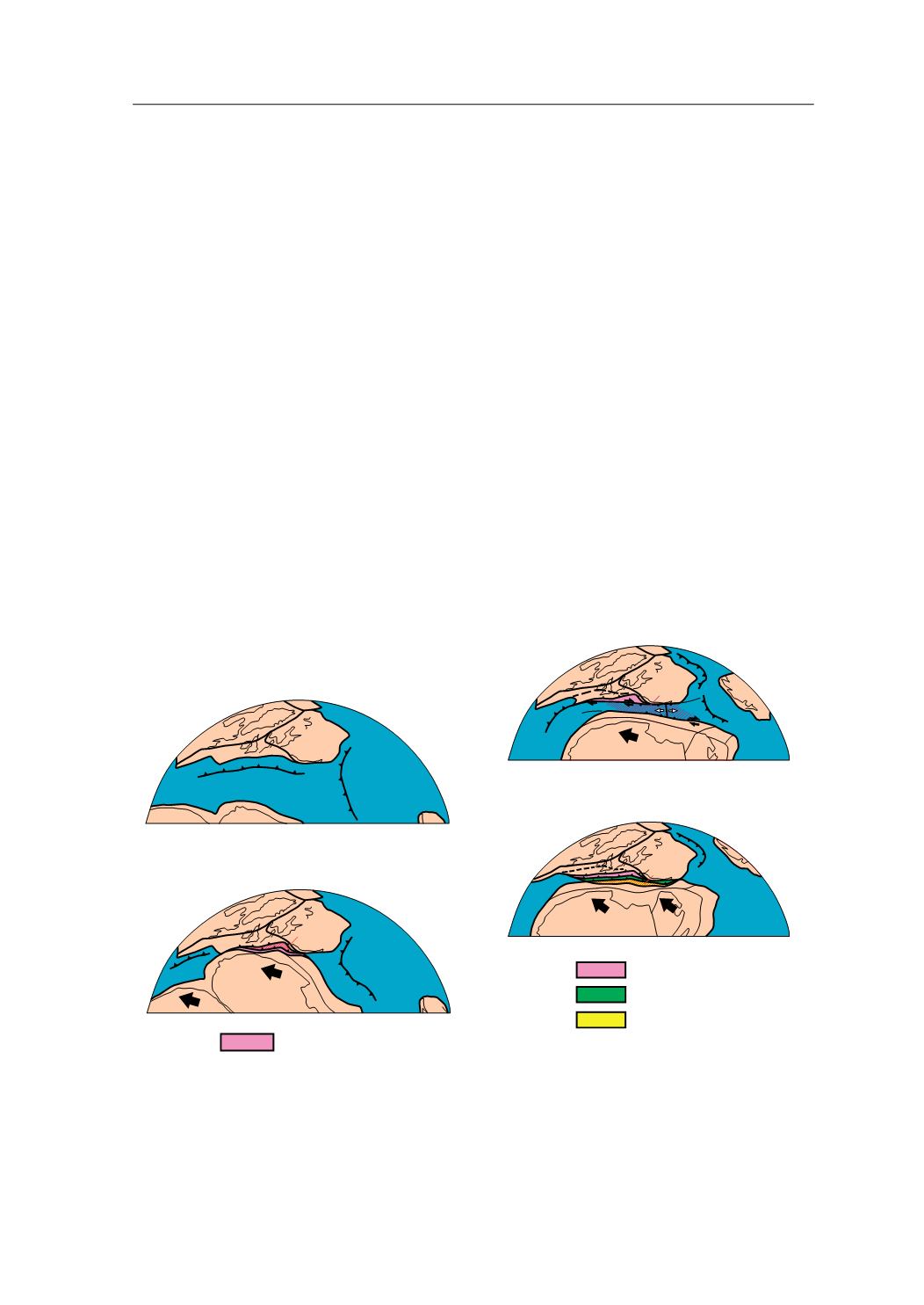
Fig.3.
Reconstructionsof(a)theRheicOceanrealmattheSilurian
—
Devonianboundary,
and(b)theinitialcollisionbetweenGondwanaandLaurussiaatc.410
–
400 Ma,following
the complete closure of the Rheic Ocean. This collision caused subduction of the most
external margin of Gondwana and generated the HP
–
UHP metamorphic belt preserved
in the allochthonous Upper Units exposed in the Variscan suture. The true Rheic Ocean
suture is not represented in the mapped area of NW Iberia.
c.395 Ma
Generation of an oceanic microplate.
GONDWANA
BALTICA
LAURENTIA
AVALONIA
ARCTIDA
URALIAN
ASIATIC
RHEIC
OCEAN
SIBERIA
PULLAPART
BASIN
Rhenohercynian
c.380-370 Ma
Second collision: Ophiolite obduction and second HP - event.
GONDWANA
BALTICA
LAURENTIA
AVALONIA
ARCTIDA
URALIAN
ASIATIC
RHEIC
OCEAN
PALEOTETHYS
c.395Ma
OPHIOLITE
HPBELT
Rhenohercynian
UPPER UNITS
OPHIOLITIC UNITS
BASAL UNITS
(a)
(b)
Fig. 4.
Reconstructions showing (a) dextral motion between Gondwana and Laurussia,
which favored the opening of a rather ephemeral pull-apart basin at c. 395 Ma with
generation of new oceanic lithosphere, and (b) the second and
fi
nal collision at c. 380
–
370 Ma,whichcausedtheaccretionofbuoyantoceaniclithospherefollowedbynewsub-
ductionaffectingthemarginofGondwana,therebydevelopingasecondHP
–
LITmetamor-
phic belt. The two different HP belts and the ophiolitic units dated at c. 395 Ma can be
identi
fi
ed in the allochthonous terranes that outline the Variscan suture from Iberia to
the Bohemian Massif.
760
R. Arenas et al. / Gondwana Research 25 (2014) 756
–
763
8. TWO STAGE COLLISION
209