


 226 / 352

and ages: the Upper Ophiolitic Units of Devonian age and the Lower
Ophiolitic Units of Cambrian age. The occurrence of a thick serpentinite
mélange at the base of the allochthonous pile was interpreted in
the context of dextral convergence (Somozas mélange,
Fig. 2
;
Arenas
et al., 2009
).
The
fi
nal collision between Gondwana and Laurussia started at c.
370 Ma as a consequence of continued oblique dextral convergence
(
Díez Fernández et al., 2012b
). It caused renewed north-directed
subduction affecting a new section of the external Gondwanan margin
with a more easterly provenance (in Gondwanan margin coordinates;
Basal Units;
Díez Fernández et al., 2010; Fuenlabrada et al., 2012
). This
is the suggested setting for the development of the second HP metamor-
phic event, formed under LIT conditions and generating C-type eclogites
(
Coleman et al., 1965
), blueschists and HP metapelites (
Fig. 4
).
Convergence continued for about 70 m.y. (
Dallmeyer et al., 1997
) as
intracontinental deformation progressed southward, reaching inner
sections of Gondwana while building a foreland fold and thrust belt in
the external parts of the orogen.
4. Conclusions
Previous interpretations for the
fi
nal assembly of Pangea call upon a
single-stagecollisionbetweenGondwanaandLaurussiainCarboniferous
times. However, recent data regarding the origin and tectonothermal
evolution of the allochthonous terranes involved in the Variscan suture
suggest a more complex and longer history for the early stages in the
assembly of the supercontinent. These data are consistent with two
successive collisional events separated by the generation of a relatively
ephemeral oceanic basin. The
fi
rst collision occurred in Early Devonian
times (before c. 400
–
390 Ma) and caused deep subduction of the most
external margin of Gondwana and the generation of a HP
–
UHP
metamorphic belt (Upper Units of the Variscan suture). Continued
dextral motion between Gondwana and Laurussia favored the opening
of a relatively large pull-apart basin at c. 400
–
395 Ma. The rapid closure
of this basin started at c. 380 Ma and caused the accretion of buoyant
oceanic lithosphere of Devonian age below the northern continent.
This oceanic lithosphere is represented by the most common ophiolites
found in the European Variscan suture (Upper Ophiolitic Units). Ma
fi
c
slices with a similar age and showing greenschist facies recrystallization
were accreted later, followed by ma
fi
c complexes with Cambrian age
generated by the activity of peri-Gondwanan volcanic arcs that progres-
sively reached the collision zone as the basin shrank (Lower Ophiolitic
Units). Finally, renewed dextral convergence led to a new collision
with another section of the Gondwanan margin at c. 370 Ma and the
generation of a second HP
–
LIT belt (Basal Units). Convergence continued
during the Carboniferous producing the complex intracontinental
deformation that characterizes the Variscan belt.
Acknowledgments
Financial support for this research has been provided by the Spanish
project CGL2012-34618 (Ministerio de Economía y Competitividad).
Insightful reviews of the manuscript performed by Rob Strachan and
an anonymous reviewer are gratefully acknowledged, as well as the
excellent editing work of R. Damian Nance that signi
fi
cantly improved
the
fi
nal version of the manuscript. This paper is a contribution to
Project 597 of the International Geological Correlation Programme:
"Amalgamation and Breakup of Pangaea: the type example of the
supercontinent".
References
Ábalos, B., Puelles, P., Gil Ibarguchi, J.I., 2003. Structural assemblage of high-pressure
mantle andcrustal rocks ina subduction channel (Cabo Ortegal, NW Spain). Tectonics
22, 1006.
http://dx.doi.org/10.1029/2002tc001405 .Abati, J., Dunning, G.R., Arenas, R., Díaz García, F., González Cuadra, P., Martínez Catalán,
J.R., Andonaegui, P., 1999.
Early Ordovician orogenic event in Galicia (NW Spain):
evidence from U
–
Pb ages in the uppermost unit of the Ordenes Complex. Earth and
Planetary Science Letters 165, 213
–
228.
Abati, J., Castiñeiras, P., Arenas, R., Fernández-Suárez, J., Gómez Barreiro, J., Wooden, J.,
2007.
Using SHRIMP-RG U
–
Pb zircon dating to unravel tectonomagmatic events in
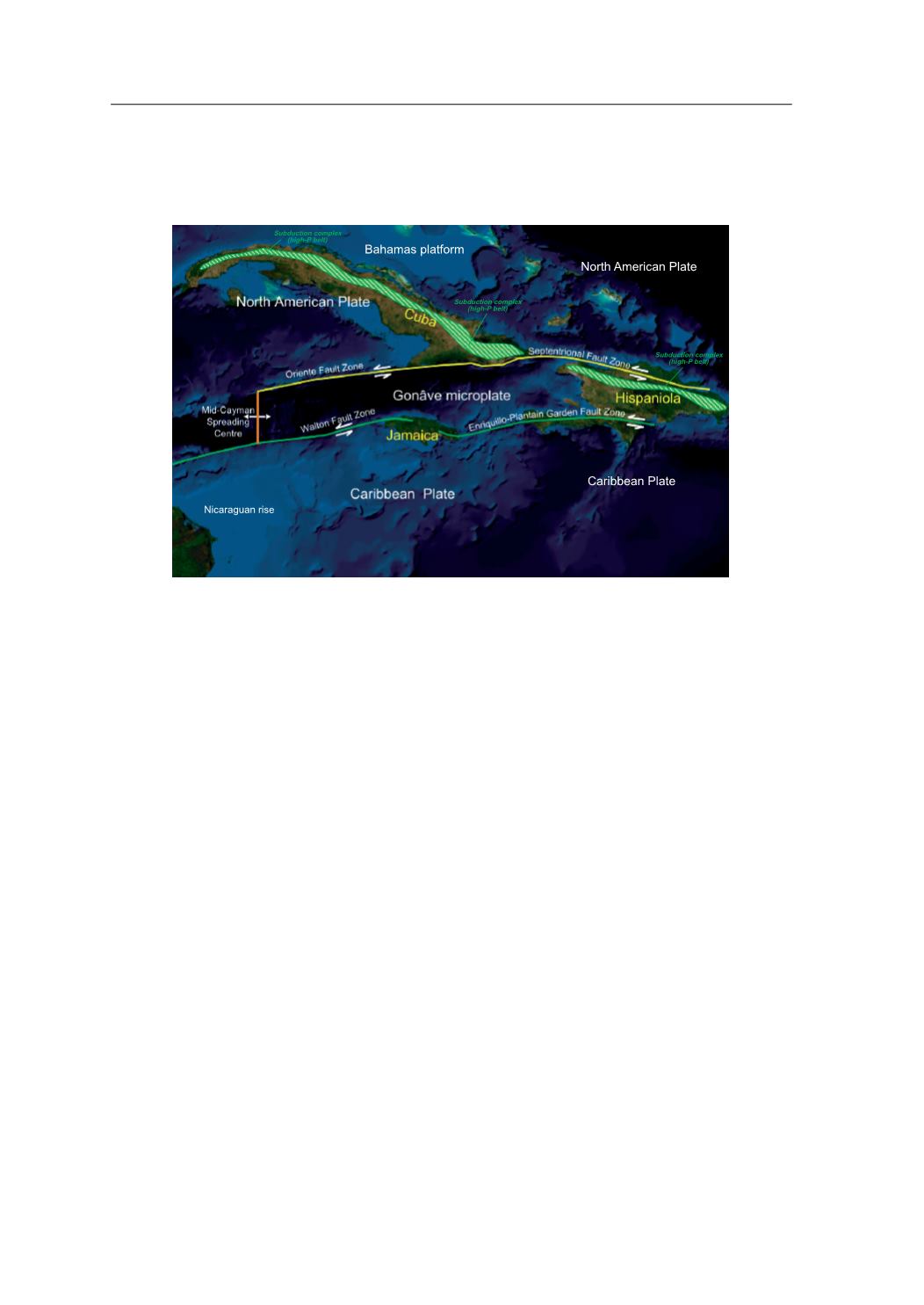
Fig. 5.
Sketch showing the present plate distribution in the North Caribbean region. Initial interaction between the North American and Caribbean plates generated the HP terranes and
ophioliteslocated innorthernCubaandHispaniola.The opening ofa longpull-apartbasin, which can befollowed for more than 2500 km from east to west, transectedthe HPbelts and
generatednewoceaniclithosphereintheGonâvemicroplate.(Modi
fi
edafteranoriginalNASAimagewithadditionalinformationfromWikimediaCommons;seealso
García-Cascoetal.
(2008)
and references therein for additional information about the geology of the Caribbean region).
761
R. Arenas et al. / Gondwana Research 25 (2014) 756
–
763
8. TWO STAGE COLLISION
210