


 108 / 352

3. Sample description
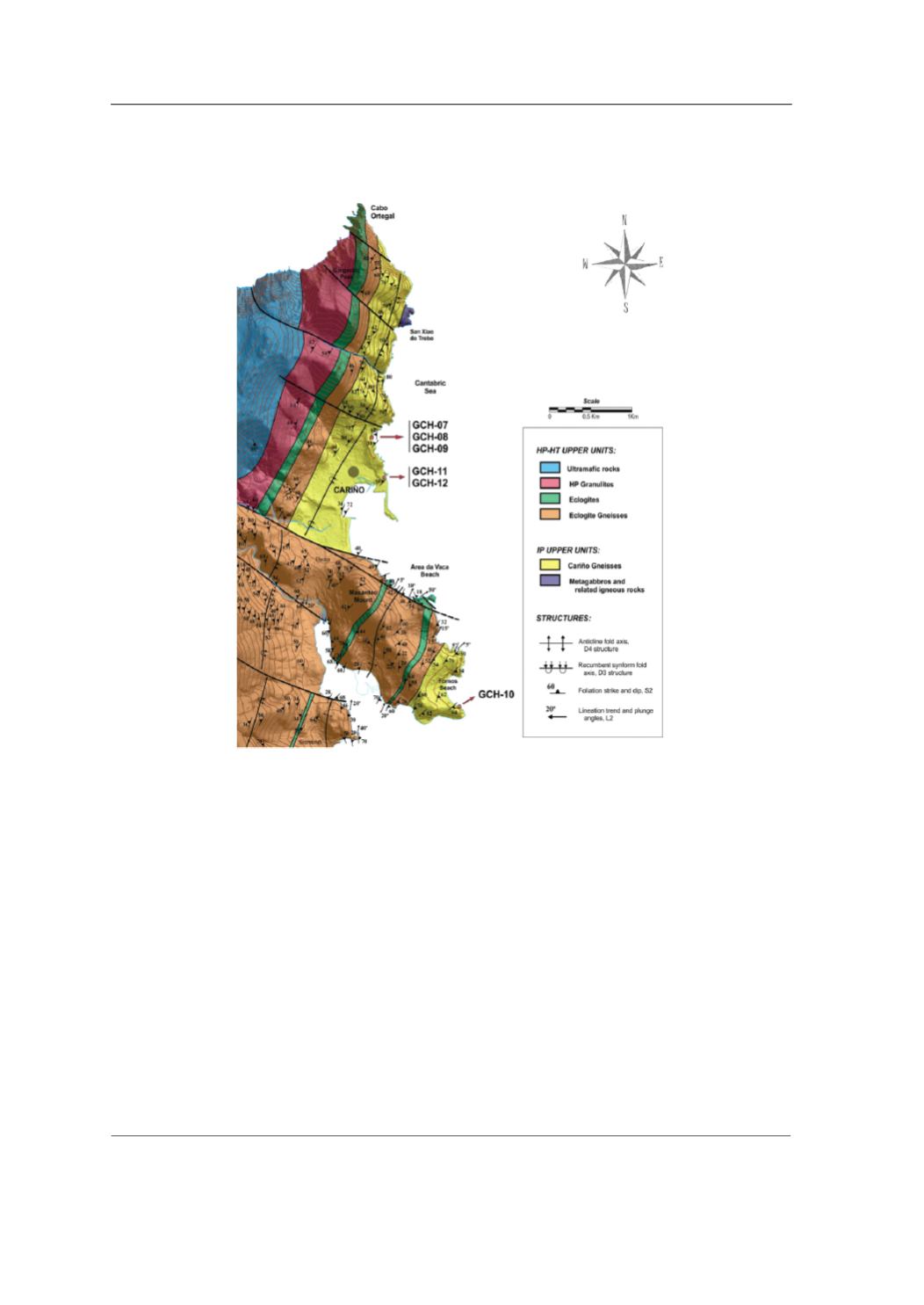
Six samples were chosen from the Cariño Gneiss formation. The loca-
tionofthese samplesisshown in
Fig.2
.SamplesGCH-07,08and09were
collectedat Peiralbeach(N43°44
′
40
″
, W7°52
′
2
″
),samplesGCH-11and
12fromtheoldshell
fi
shbreedingcentre(N43°44
′
23
″
,W7°51
′
53
″
)and
sample GCH-10fromFornosbeach(N43°42
′
41
″
,W7°51
′
5
″
;SimpleCy-
lindrical projection, WGS84 datum). All samples are texturally and com-
positionally very similar, and were selected from the medium-grained
psamitic bands instead of the
fi
ne-grained pelitic bands. Microscopically
the samples are inequigranular and medium to
fi
ne-grained, and show a
granoblastic
–
lepidoblastic texture. Qtz and Pl are the major components.
Qtz is slightly undulose and Pl is usually altered. Micas are smaller than
Qtz and Pl, Bt is usually retrogressed to Chl, and the preferred orientation
thatbothBtandMsde
fi
ne ispoorly developed. Grt are strongly corroded
and have a dusty appearance due to high abundance of inclusions. Ky
and St are very rare in the selected samples but are more abundant in
the pelitic bands of these rocks. Other constituents are Spn, Rt, Ilm,
Ap, Zrn and opaque matter (mineral abbreviations after
Kretz (1983)
).
4. Sample preparation and analytical procedures
4.1. Zircon sample preparation
Zircon crystals were separated from bulk samples using conven-
tional mineral separation techniques at the Facultad de Ciencias
Geológicas, Universidad Complutense de Madrid (UCM). Samples
were cleaned and dried before crushing them in a jaw crusher and
in a tungsten disc mill. The light fraction was removed by
fl
oatability
using a Wil
fl
ey table. The magnetic fraction was separated with a
hand magnet for the most magnetic minerals and with a Franz
model magnetic separator to remove those minerals susceptible to a
magnetic
fi
eld induced by an electric current up to 1.7 A. Minerals
with a density below 3325 kg·m
−
3
were removed using CH
2
I
2
(diiodomethane) heavy liquid. Zircon hand picking, mounting, imag-
ing and analysis were performed at the J. W. Goethe Universität of
Frankfurt am Main (GUF). Hand-picked zircons of all sizes and
morphologies were mounted in epoxy
fi
lled mounts depending on
their size and polished to approximately 50% of their thickness. All
Fig. 2.
Geological map of the Northern part of the Cariño Gneiss formation, with the location of the studied samples.
Fig.1.
GeologicalmapoftheEuropeanVariscides(a)basedon
MartínezCatalán(2011)
.Geologicalmap(b)andcross-section(c)oftheNWIberianCaboOrtegalComplex.Thelocationof
Fig.2
geologicalmapisalsoshown.Basedon
Vogel(1967)
;
Marcosetal.(1984)
;
Arenas(1988)
;
Arenasetal.(2013)
.TheUpperAllochthonisformedbytheintermediate
–
Pupperunits
and the high-p
–
high-T upper units.
1437
R. Albert et al. / Gondwana Research 28 (2015) 1434
–
1448
5. PROVENANCE OF THE UPPER ALLOCHTHON
92