


 133 / 352

6. PROVENANCE OF THE HP-HT UPPER ALLOCHTHON
117
Two-stage depleted mantle model ages (
T
DM
) were
calculated using present day
176
Hf/
177
Hf
=
0.283164
value for average MORB (Chauvel
et al.
, 2008)
which is assumed to be present-day depleted mantle
composition. This value corresponds to an initial
e
Hf
(
t
= 0 Ga)
=
13.4. DM evolution trend was propa-
gated to
e
Hf
(
t
= 4 Ga)
=
0, because the existence of a
voluminous-depleted mantle reservoir during Hadean
is highly speculative (see discussions in Hawkesworth
et al.
, 2010; Kemp
et al.
, 2010 and Zeh
et al.
, 2011).
T
DM
values for all data were calculated using a mean
176
Lu/
177
Hf of 0.0113 (average continental crust;
Rudnick & Gao, 2003).
MORB
176
Hf/
177
Hf interval was taken from the
Atlantic, Pacific and Indian MORB values (excepting
three unusual low values from the Indian Ocean)
reported by Chauvel & Blichert-Toft (2001)
considering a minimum
176
Hf/
177
Hf
=
0.28302
(
e
Hf
(
t
= 0 Ma)
=
8.3) and a maximum
176
Hf/
177
Hf
=
0.28337 (
e
Hf
(
t
= 0 Ma)
=
20.7). These values are prop-
agated to
e
Hf
(
t
= 4 Ga)
=
0, defining a field (blue dis-
continuous lines) around the DM-evolution trend, to
provide an indication of the likely range of DM com-
positions through time.
Sm
–
Nd whole-rock analyses
Sample preparation and analyses were performed at
the laboratory of Geocronologıa y Geoquımica
Isotopica at the UCM. Whole-rock samples were
dissolved by oven digestion in ultra-pure HF and
HNO
3
acids together with the
149
Sm/
150
Nd spike in
sealed teflon microreactors. Once the samples were
dissolved and dried, HNO
3
was added to eliminate
silica fluorides and then HCl was added to form
chlorine molecules. The sample was then subjected
to a two-stage conventional ion-exchange chro-
matography. The fractions where Sm and Nd were
present in high concentrations were dried and
loaded with H
3
PO
4
on rhenium filaments in triple
disposition, and analysed in a thermal ionization
mass spectrometer TIMS-Phoenix HCT040 follow-
ing a dynamic multicollector method. The measured
143
Nd/
144
Nd isotopic ratios were corrected for pos-
sible isobaric interferences from
142
Ce and
144
Sm
(only for samples with
147
Sm/
144
Sm
<
0.0001) and
normalized to
146
Nd/
144
Nd
=
0.7219 (O’Nions
et al.
,
1977) to correct for mass fractionation. The LaJolla
Nd international isotopic standard was analysed
during sample measurement, and gave an average
value of
143
Nd/
144
Nd
=
0.511847 for nine replicates,
with an internal precision of 0.000008 (2
r
). These val-
ues were used to correct the measured ratios for possible
instrumental bias following reference values from Lug-
mair
et al.
(1983). The analytic errors for
147
Sm/
144
Nd
ratio is 0.1% and for
143
Nd/
144
Nd is 0.006%. CHUR
present-day values considered for this study are
147
Sm/
144
Nd
=
0.1967 (Jacobsen & Wasserburg, 1980)
and
143
Nd/
144
Nd
=
0.512638 (Hamilton
et al.
, 1983).
The DM evolution trend and DM model ages (
T
DM
)
have been calculated as described by DePaolo (1981)
using
147
Sm/
144
Nd ratios and MDAs for each sample
(Fig. 9). A
147
Sm decay constant of 6.539
9
10
11
a
1
has been used, calculated from
147
Sm half-life reported
by Lugmair & Marti (1978) and Begemann
et al.
(2001). MORB epsilon values of
+
7 to
+
12 used are
those reported by DePaolo &Wasserburg (1976).
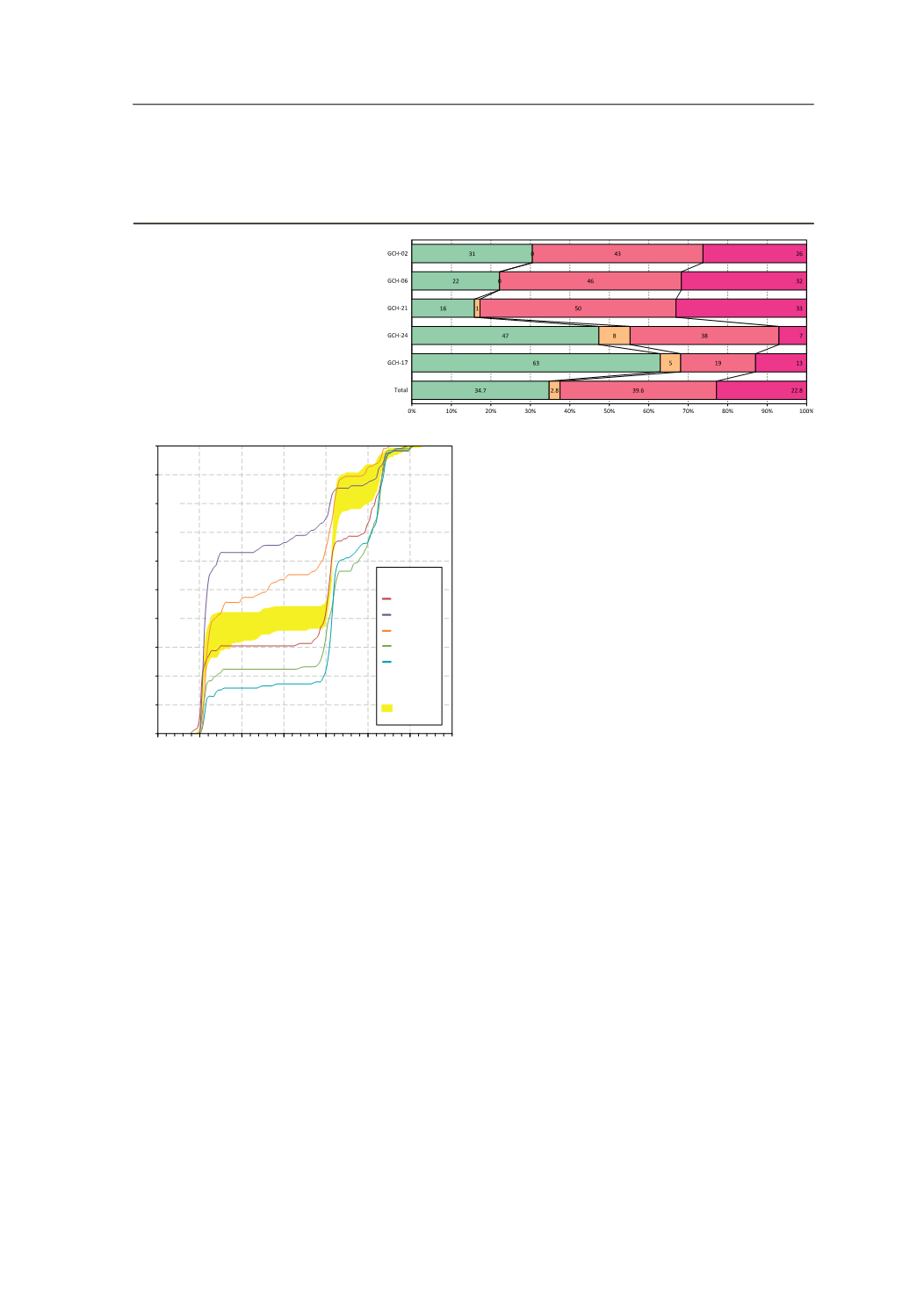
Fig. 5.
Relative abundance of Banded
Gneisses U
–
Pb zircon ages for each
significant age population represented as
bar diagrams, for each sample and for the
total U
–
Pb zircon analyses. Green:
Palaeozoic and Neoproterozoic; yellow:
Mesoproterozoic; pale pink:
Paleoproterozoic; dark pink: Archean
population.
0
0.1
0.2
0.3
0.4
0.5
0.6
0.7
0.8
0.9
1
0
500 1000 1500 2000 2500 3000
Age cumulative probability
(Ma)
GCH-02
GCH-06
GCH-17
GCH-21
GCH-24
Cariño
Gneisses
HP-HT Upper
Allochthon:
IP Upper
Allochthon:
Fig. 6.
Cumulative density plots for each of the HP
–
HT
Upper Allochthon samples, and for the IP Upper Allochthon.
©
2015 John Wiley & Sons Ltd
PROVENANCE OF THE HP
–
HT VARISCAN TERRANE
967