


 230 / 352

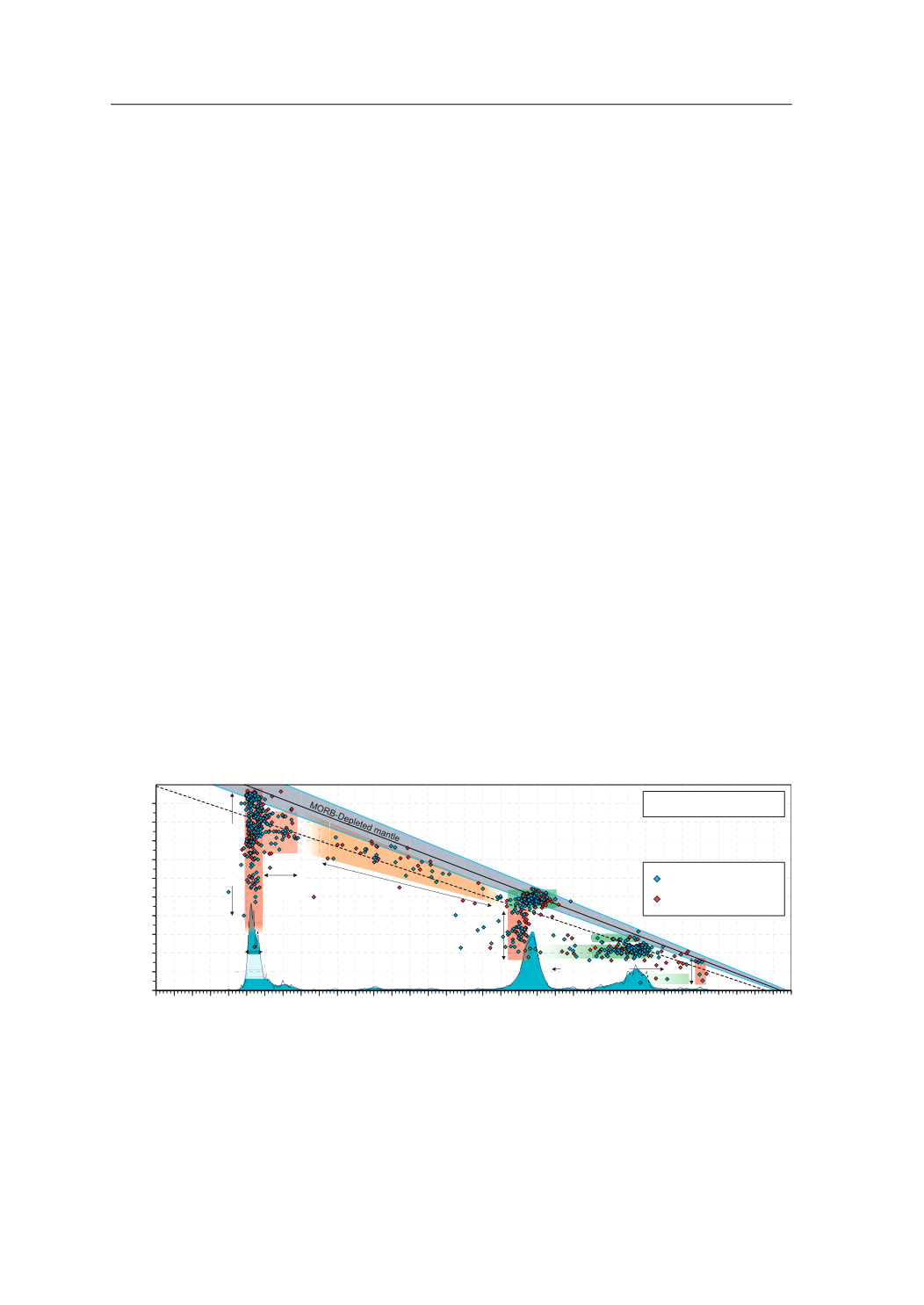
Craton (WAC). The Paleoproterozoic population
has been linked to the Eburnean Orogeny and its
provenance has been assigned as to be from the
Eastern Reguibat Rise (also in the WAC). This
population shows that the Eburnean depleted
mantle derived magmas intruded at around
c.
2.07 Ga in the Archean crust, represented by the
above-mentionedArchean population, triggering
mixing processes (Fig. 1). The Mesoproterozoic
population of these metasedimentary rocks is
scarce and scattered so problems arise when
assigning its provenance, because the WAC has
no igneous activity reported at this time, due to
becoming a stable craton. Nevertheless, from the
isotopic information and from the information
of recently discovered dykes it has been proposed
that this population is also WAC derived.
The young detrital spectrum (< 1 Ga) from the
studied formations is proved to have been derived
from the erosion of a magmatic ar
c.
The initial
development of this arc has been constrained
between
c.
780 and 590 Ma, defined as the
“proto-arc stage”, where mainly crustal recycling
took place (Fig. 1). Between 590 and 490 Ma,
the “arc-stage”, intrusion of juvenile magmas
took place triggering intense mixing processes
with an Eburnean and Archean crust (and with
a small proportion of reworked early arc crustal
material). This arc is interpreted as having been
built in the margin of Gondwana, specifically
at the WAC, where a long lived subduction of
oceanic crust directed to Gondwana should
necessarily have occurred. This arc is proposed
to be the Cadomian arc and probably represents
a late development of its orogeny compared to
where it has been defined (see chapters 5 & 6 for
details).
The maximum depositional age for the
siliciclastic series of the HP–HT Banded Gneisses
is
c.
521 Ma, and of the IP Cariño Gneisses is
c.
510 Ma. Taking into account crystallisation
ages of intrusive igneous rocks of the Banded
Gneisses, the protolith of was a Middle Cambrian
siliciclastic sedimentary series.
From the U–Pb age distribution patterns it is
proposed that the protoliths of the sedimentary
rocks involved in both formations may have been
deposited in a back-arc type basin, where the
volcanic arc system was very active, shedding its
juvenile materials into the basin at the same time
as the adjacent WAC supplied the Eburnean and
Archean detritus.
The main difference between the U–Pb age
distributions of both formations is that the
Banded Gneisses has an abundant
c.
590–540
Ma Ediacaran population and the Cariño Gneiss
214
9. FINAL DISCUSSION AND CONCLUSIONS
F
UHF\FOLQJ WUHQG
³DUF´
&+85
PL[LQJ WUHQG
³SURWR DUF´
F
"
Ϭ͘ϮϴϬϲ
Ϭ͘ϮϴϬϴ
Ϭ͘ϮϴϭϬ
Ϭ͘ϮϴϭϮ
Ϭ͘Ϯϴϭϰ
Ϭ͘Ϯϴϭϲ
Ϭ͘Ϯϴϭϴ
Ϭ͘ϮϴϮϬ
Ϭ͘ϮϴϮϮ
Ϭ͘ϮϴϮϰ
Ϭ͘ϮϴϮϲ
+I +I
Ϭ
ϱϬϬ
ϭϬϬϬ
ϭϱϬϬ
ϮϬϬϬ
ϮϱϬϬ
ϯϬϬϬ
DĂ
@
6QQFS "MMPDIUIPO
%DQGHG *QHLVVHV
Q
&DULxR *QHLVVHV
Q
Fig. 1.
176
Hf/
177
Hf
v.
age plot for detrital zircon data of the Upper Allochthon. Horizontal green shaded areas represent
crustal recycling trends with
176
Lu/
177
Hf = 0. Vertical red shaded areas represent mixing between juvenile and recycled
crustal material formed in magmatic arcs. The orange shaded area represents a source that developed through time with a
similar
176
Lu/
177
Hf ratio as the CHUR and the DM, from which the Mesoproterozoic zircon crystallized. MORB
176
Hf/
177
Hf
interval was taken from the Atlantic, Pacific and Indian MORB values (excepting three unusual low values from the Indian
Ocean) reported by Chauvel & Blichert-Toft (2001) considering a minimum
176
Hf/
177
Hf = 0.28302 (
H
Hf
(t=0Ma)
= +8.3) and
a maximum
176
Hf/
177
Hf = 0.28337 (
H
Hf
(t=0Ma)
= +20.7). These values are propagated to
H
Hf
(t=4Ga)
= 0 defining a grey field
(enclosed by the blue discontinuous lines) around the DM-evolution trend, to provide an indication of the likely range of
DM compositions through time.
n
, number of concordant zircon analyses (90–100% conc.), analysed for Lu–Hf isotopes.
MORB: mid-ocean ridge basalts; DM: depleted mantle; CHUR: chondritic uniform reservoir.