


 184 / 352

168
7.4.1. Sample GCH-01
(Cariño´s beach ultramafic zone orthogneiss)
This sample was collected from the north-
ern coast of the
Masanteo
peninsula (Appx. 1;
43°43’46.6”N, 7°52’07.5”W).
This orthogneiss outcrops as a
c.
30
centimetre-thick leucocratic felsic rock within
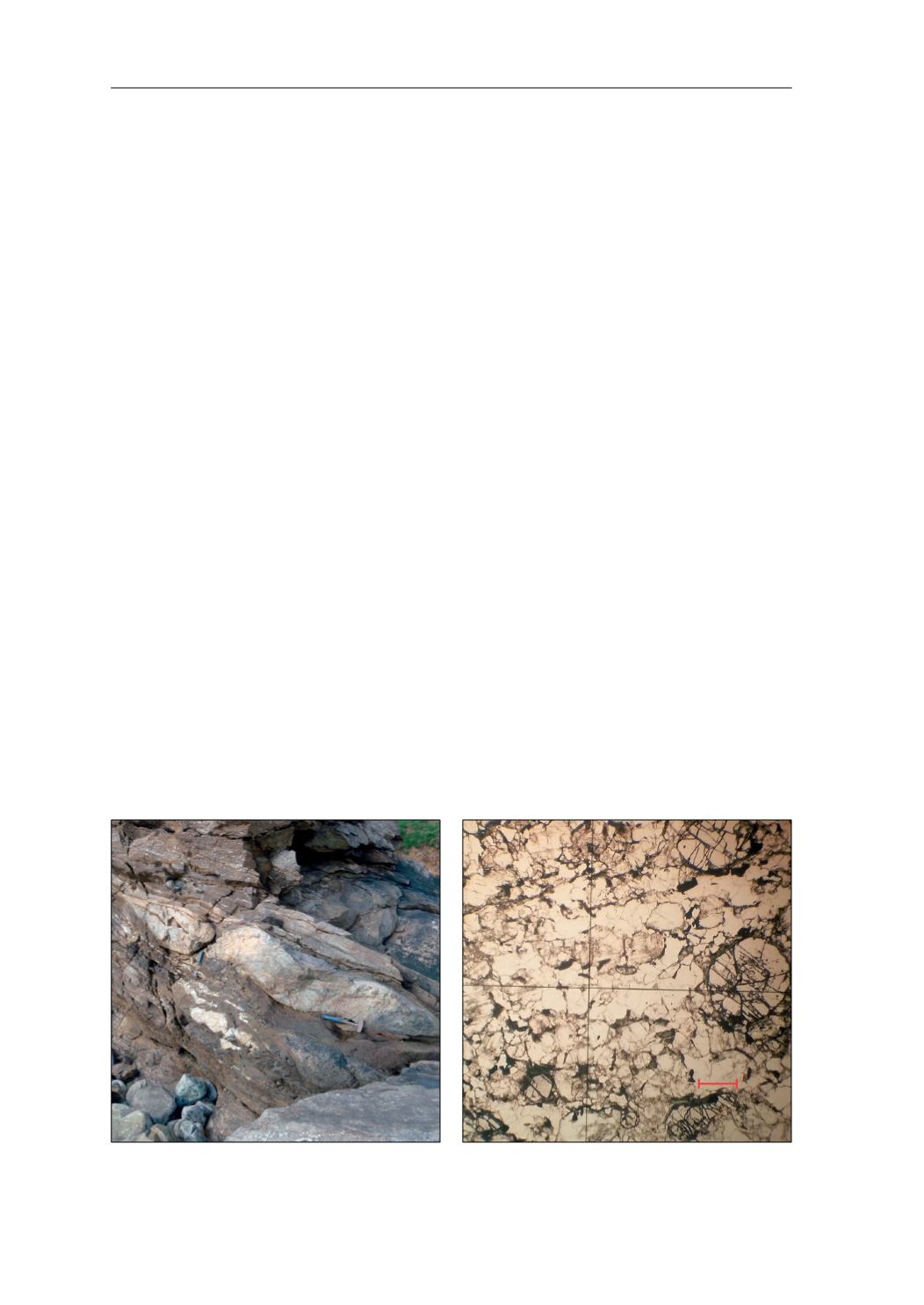
the metasedimentary rocks. It is displayed as a
boudin wrapped by the metasedimentary rocks
with strong regional foliation development (Fig.
50). It shows a different and younger foliation
than the regional one. It outcrops at the northern
coast of the
Masanteo
peninsula, in the same
outcrop as eclogite GCH-20 (section 7.3.2) and
the metasedimentary rock GCH-02 (chapter 6).
From microscopic observations this sample
has a porphyro-granoblastic texture (Fig. 51;
Ref: 112973). Grt porphyroblasts are colourless,
subidioblastic and poikilitic, with a high amount
of inclusions within their cores (Qz, Chl and Ap).
The matrix is formed by Qz, Afs, Pl and small
Grt. The grain sizes are varied. Qz, Afs and Pl
are displayed as small crystals with straight grain
boundaries and triple junctions (granoblastic
polygonal texture) but also as bigger crystals with
irregular grain boundaries. Other constituents
are Zrn, Ap, Chl, Rt and Ilm.
7.4.1.1. Results
From this sample (GCH-01), 165 U–Pb
analyses were performed of which 140 were
concordant (
d
= 12.1%; Figs. 52 & 53). The U–
Pb ages show two maximum abundance peaks at
496 (domain I, zircon age range between 518 and
466 Ma) and 402 Ma (domain II, zircon age range
between 410 and 381 Ma; Fig. 53). 16 analyses
gave ages between
c.
700 and
c.
540 Ma; and three
analyses gave Paleoproterozoic ages.
Domain I zircon (
c.
500 Ma) shows oscillatory
and multi-faceted (“soccerball”) habits (Fig. 54).
These zircon grains are normally surrounded
by very bright rims (interpreted as alteration
fronts), which have not been analysed due to
spatial resolution issues, and another rim, which
is darker from CL images than the previous
bright rim and domain I zircon. This darker rim
is associated with domain II zircon (
c.
400 Ma).
Domain II shows badly defined faded oscillatory
zonings. Some zircon grains have dark cores with
patchy or chaotic textures, which in BSE images
show a high amount of inclusions (Fig. 54).
With the exception of one domain II analysis
(A456; 401 Ma;
H
Hf
(t)
= -7.5) and analyses from
zircon with older ages than 540 Ma (which are
considered inheritances), all zircon have positive
H
Hf
(t)
values(Fig. 55a). All domain I zircon plot
Fig. 50.
Field photograph of the studied sample. The
hammer is 40.6 cm long.
Fig. 51.
Phtomicrograph of the studied sample.
ȝP
7.4. ORTHOGNEISSES