


 159 / 352

143
7.2.3. Sample GCH-32
(Area da Vaca leucosome, 205 m)
This sample was collected from the
Area da
Vaca
beach (43°43’29.34”N, 7°51’38.25”W), at
the 205 m point of the
Area da Vaca
geological
section (chapter 4).
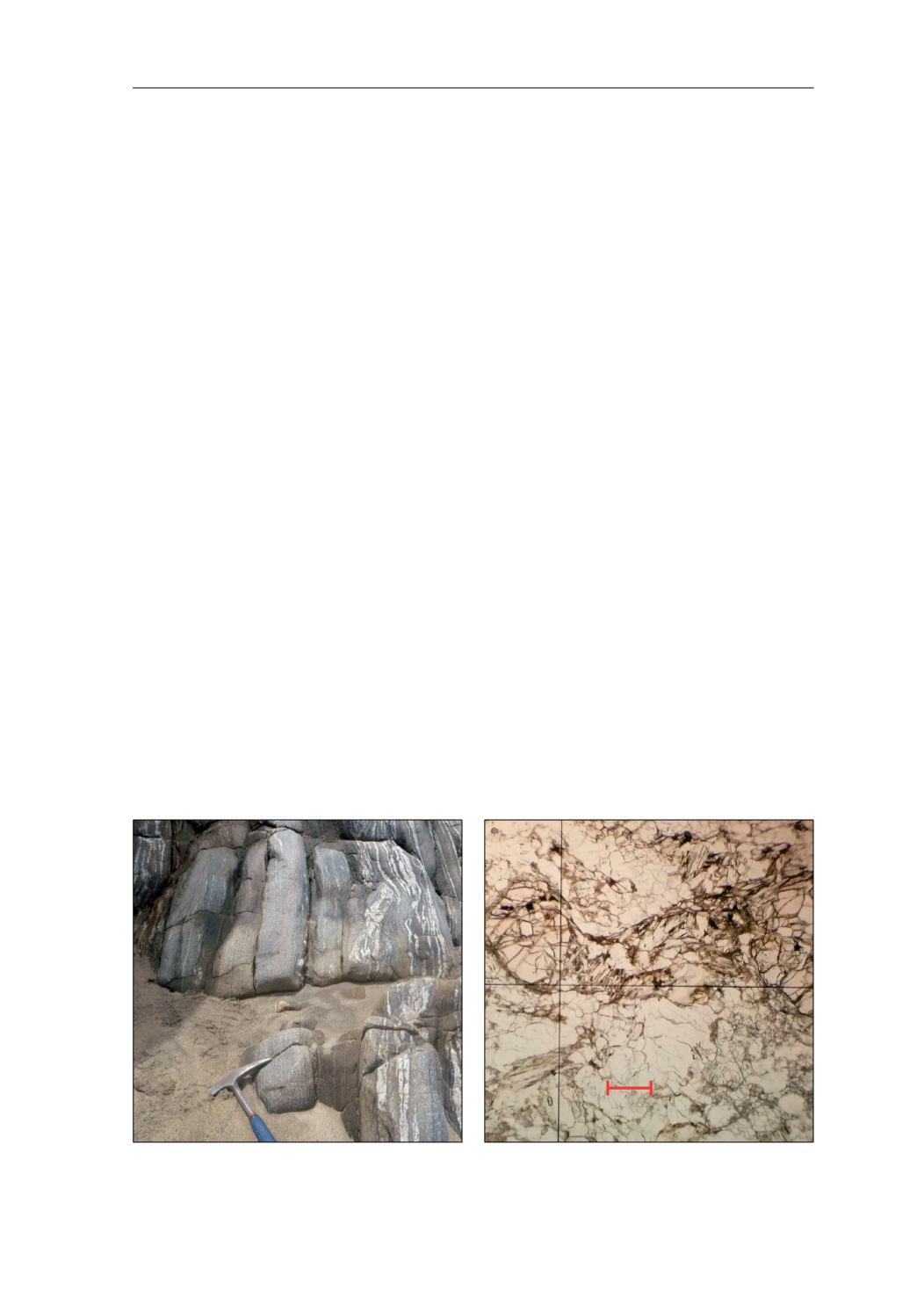
This sample is interpreted from field
observations as a leucosome, formed by partial
melting of the metasedimentary rocks (Fig. 15).
This lithology is displayed as centimetre sized
leucocratic bands, folded and coherent with the
metasedimentary rocks regional foliation (Ref:
114095).
From microscopic observations this sample
has a porphyro-grano-lepidoblastic texture and
has Qz and Afs as major constituents (Fig. 16).
Qz is displayed as big poikilitic crystals and as
small crystals. These two ways in which Qz
is present in this sample could be due to a re-
partial melting of the leucosome or that the small
crystals are inherited from the metasedimentary
rock from which this leucosome partially melted
from. Poikilitic Qz contains inclusions of Qz,
Pl, Grt, Bt and Ap. Afs is poikilitic and contains
inclusions of Qz, Bt, Ap and Zrn. It is usually
altered and shows pertitic type exsolutions.
Minor constituents are Grt, Bt, Ap, Zo, white
mica, Chl and Zrn. Grt is displayed in two ways,
as relatively big crystals with a high presence of
inclusions (Qz and Ap), highly fractured and
corroded and rimed with Bt, Qz and white mica;
and as relatively small crystals, with almost no
inclusions (or very small to be appreciated),
which are predominantly present in the Qz-Afs
regions.
7.2.3.1. Results
From sample GCH-32, 61 U–Pb analyses were
performed of which 30 were concordant (
d
=
51%; Figs. 17 & 18a,b). Domain II is defined by
14 Devonian analyses constrained between 358
and 408 Ma, and with a well-defined maximum
abundance at 394 Ma. Domain I is defined by
13 Cambrian–Ordovician analyses that show a
well-defined maximum abundance at 490 Ma,
and relative abundance peaks at 486, 496 and 521
Ma. One analysis is Ediacaran and two analyses
are Paleoproterozoic (Fig. 18b).
Most of the domain I zircon (Cambrian–
Ordovician) shows more or less well defined
oscillatory zonings. It is normally surrounded
by lobulated sinuous rims, which are dark in
CL images and bright in BSE images. Domain
II (Devonian) zircon is displayed as rims
surroundingdomainIzirconandasnewlyformed
dark zircon. It shows well defined combined
oscillatory and multi-faceted (“soccerball”)
textures. In some zircon rims these textures are
Fig. 15.
Field photograph of the studied sample. The
hammer is 33 cm long.
Fig. 16.
Photomicrograph of the studied sample.
ȝP
7.2. LEUCOSOMES