


 165 / 352

149
7.3.1. Sample GCH-19
(Ortegal lighthouse eclogite)
This eclogite forms part of the Eclogite Band
formation of the HP–HT Upper Allochthon of
the Cabo Ortegal Complex, and is representative
of the common MORB-type eclogites. This
sample is located in the northern part of the
Cabo Ortegal Eclogite Band formation (Appx. 1;
43°46’06”N, 7°52’05”W).
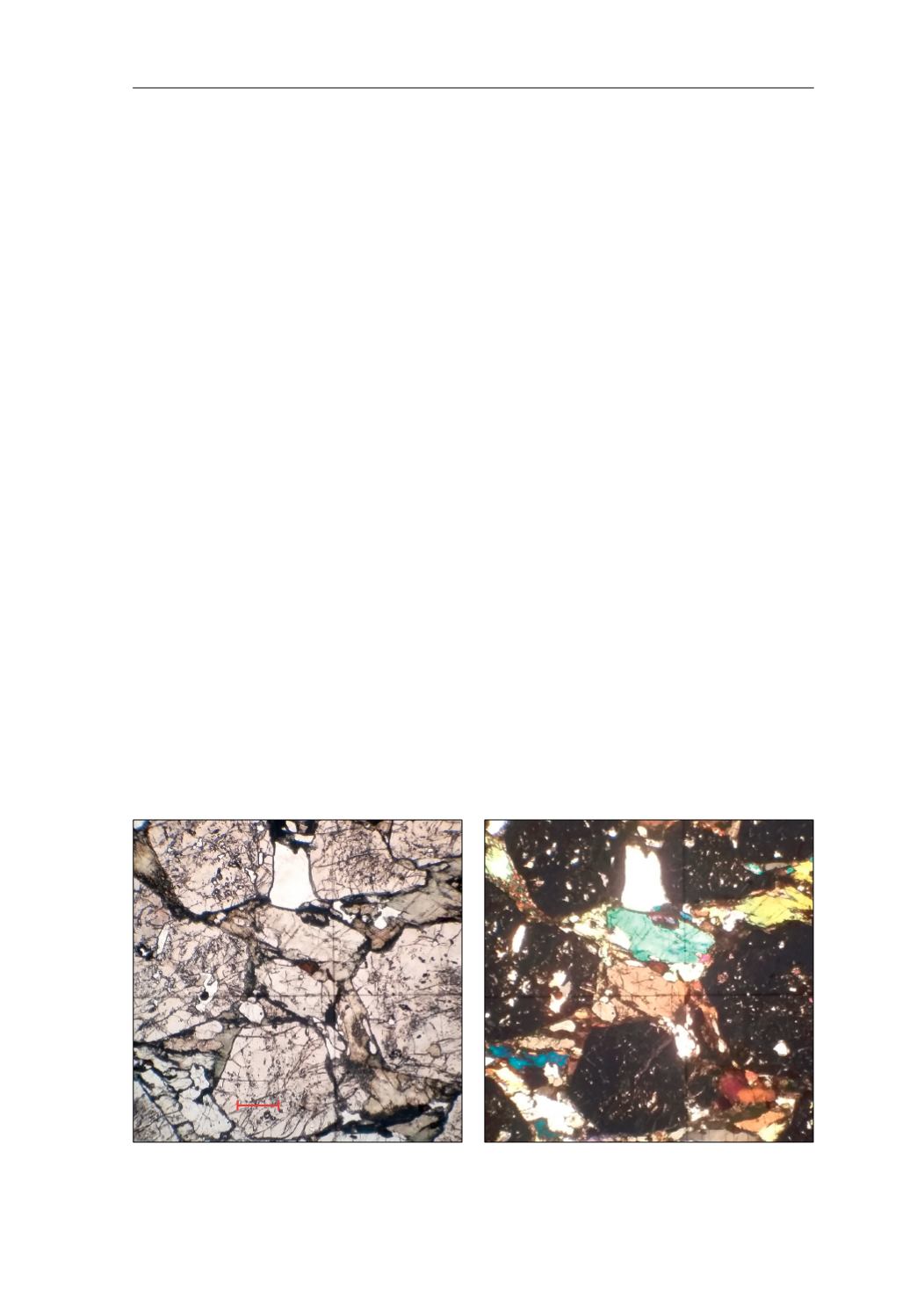
This sample is a fine to medium grained rock
with oriented porphyro-grano-nematoblastic
texture (Ref: 113162). Its major constituents
are Grt, Cpx and Zo and its minor constituents
are Qz, Amp, Pl, Rt, Ilm, Spn, Czo, Ap and Zrn
(Figs. 22 & 23). Grt is idioblastic, colourless to
light pink and poikilitic, with many inclusions
(mainly Qz, Rt, Zo, Amp and Cpx). It shows
de-compressive related coronas with micro- to
crypto-crystalline minerals where Amp and Qz
have been identified. Cpx is colourless and forms
elongated crystals defining the foliation trend.
Its borders are rimed by symplectites, which
are probably Pl and Amp or Pl and secondary
Cpx. These symplectites are a retrograde texture
and therefore this Cpx is most probably the
primary eclogitic Cpx,
i.e.
Omp. Amp, which is
most probably Hbl, is light to dark green and
also pale brown. It is slightly pleochroic and it
is poikilitic, with inclusions of at least Cpx, Rt,
Zo and Ap minerals. Zo is in net contact with
Cpx, forms elongated tabular crystals coherent
with the foliation trend and it is sometimes
partially replaced by Czo. Zo is most probably a
primary eclogitic-stable mineral. Rt is relatively
abundant, has dark opaque rims, which are most
probably Ilm, and very rarely both, Rt and Ilm,
are surrounded by Spn. Qz shows undulose
extinction, and forms polycrystalline aggregates
with lobulated crystal boundaries.
7.3.1.1. Results
From this sample 112 U–Pb analyses were
performed of which 59 were concordant (
d
= 47.3%; Figs. 24 & 25a,b). The U–Pb ages are
scattered between
c.
520 to 380 Ma with relative
abundances at 505–485, 443–424 and 402–387
Ma (Fig. 25).
Most of the zircon grains in this sample
conserve their primary oscillatory igneous
zoning but this texture is generally blurred and
fainted. Other zircon grains are structure-less.
Rims are also found and show fainted oscillatory
and structure-less zonings. Alteration fronts are
not evident (Fig. 26). No internal features are
observed in BSE images.
Epsilon Hf values are high and plot around the
MORB-DM evolution trend with values between
c.
+6 and +14 (Fig. 27a).
176
Hf/
177
Hf
(t)
ratios plot
ȝP
Fig. 22.
Photomicrograph of the studied sample.
Fig. 23.
Cross-polirazed light photomicrograph of the
studied sample.
7.3. ECLOGITES