


 167 / 352

151
data (no variation of Th/U,
176
Lu/
177
Hf,
176
Yb/
177
Hf and
176
Hf/
177
Hf
(t)
ratios relative to U–
Pb ages), these rims were not likely formed by a
dissolution-reprecipitation process (
i.e.
they are
not
s.s.
overgrowths). Furthermore, this lack of
isotopic ratio variations is shown by the whole
sample zircon population (Figs. 27 & 28). These
observations strongly suggest that a
c.
387 Ma
high-grade metamorphic event induced solid-
state zircon pseudomorphic recrystallisation,
triggering U–Pb age rejuvenation via Pb-loss
processes of the zircon that crystallised in the
gabbroic or basaltic protolith at
c.
485 Ma. Lu–
Hf analyses of all 15 concordant zircon domains
yielded similar
176
Hf/
177
Hf
(t)
values within error of
0.282812 ± 0.000110 (±2 SD; Fig. 27b). This error
is relatively high due to two analyses with slightly
lower values (Fig. 27b).This data indicates that all
zircon domains were formed from an isotopically
almost-homogeneous source. Furthermore, Fig.
27a shows that the protolithic gabbroic-basaltic
rock crystallised shortly after it was extracted
from a DM source, confirming its MORB affinity
(Bernard-Griffiths
et al.
, 1985; Peucat
et al.
, 1990;
Gil Ibarguchi
et al.
, 1990; Mendía, 2000).
$
$
ڙ
$
$
ڙ
$
$
ڙ
$
$
ڙ
$
ڙ
ȝP
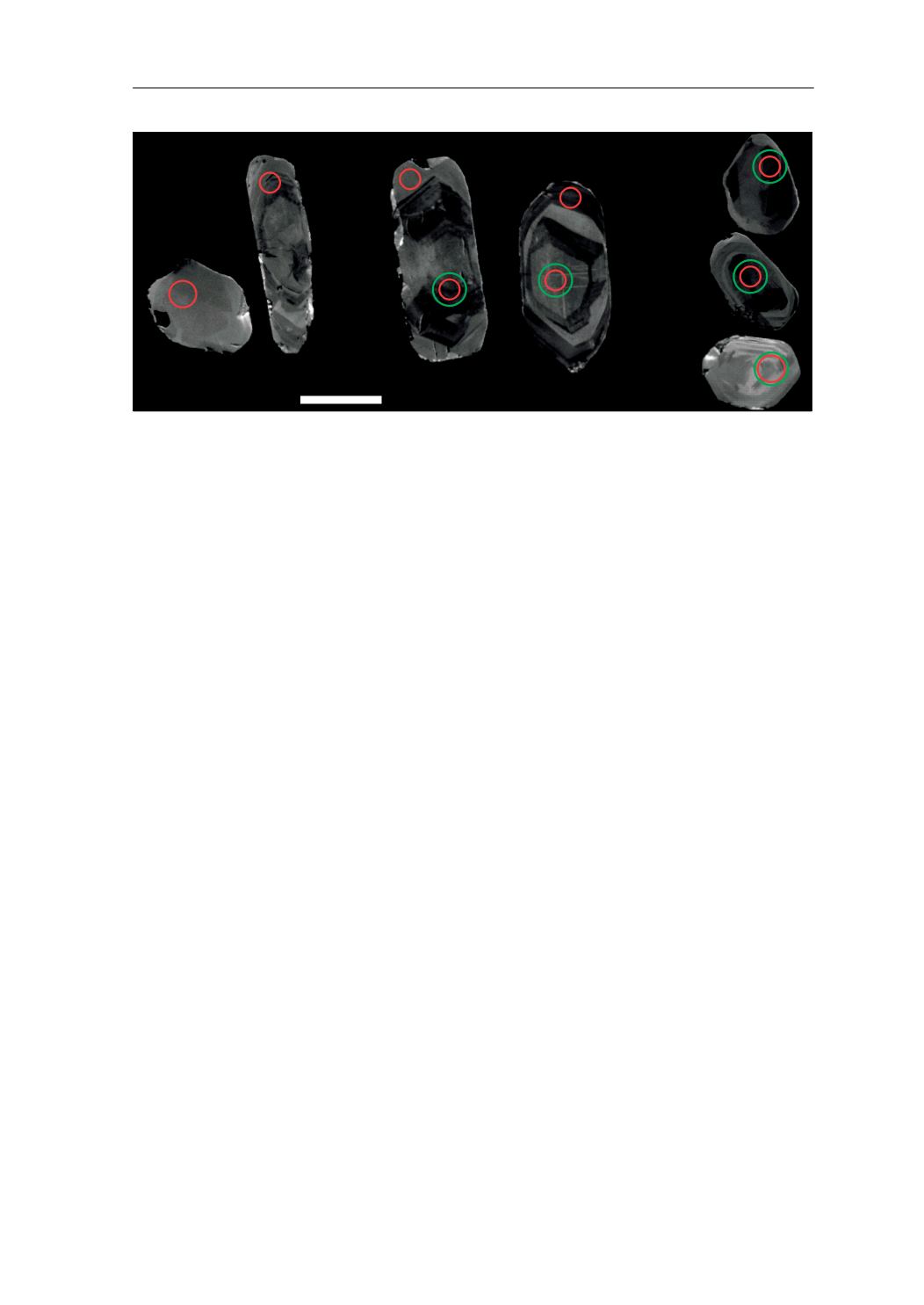
Fig. 26.
CL (cathodoluminescence) images of representative zircons from the studied sample. Laser ablation pits for U–Pb
analyses (red line circles) have 30
μ
m diameters. Laser ablation pits for Lu–Hf analyses (green line circles) have 33
μ
m
diameters. White numbers are the reference number of the analysis, red numbers are the U–Pb age and its 2
σ
error (Ma)
and the green numbers are the
H
Hf values for the U–Pb age.
7.3. ECLOGITES