


 169 / 352

153
7.3.2. Sample GCH-20
(Cariño´s beach ultramafic zone eclogite)
This sample is a centimetre size eclogite boudin
that outcrops within the Banded Gneiss meta-
sedimentary rocks (HP–HT Upper Allochthon,
Cabo Ortegal Complex). It is located in the
northern part of the
Masanteo
peninsula (Appx.
1; 43°43’46.6”N, 7°52’09.3”W).
The locality or area where this sample
outcrops contains the less retrograded eclogites
found in the Banded Gneiss formation. The less
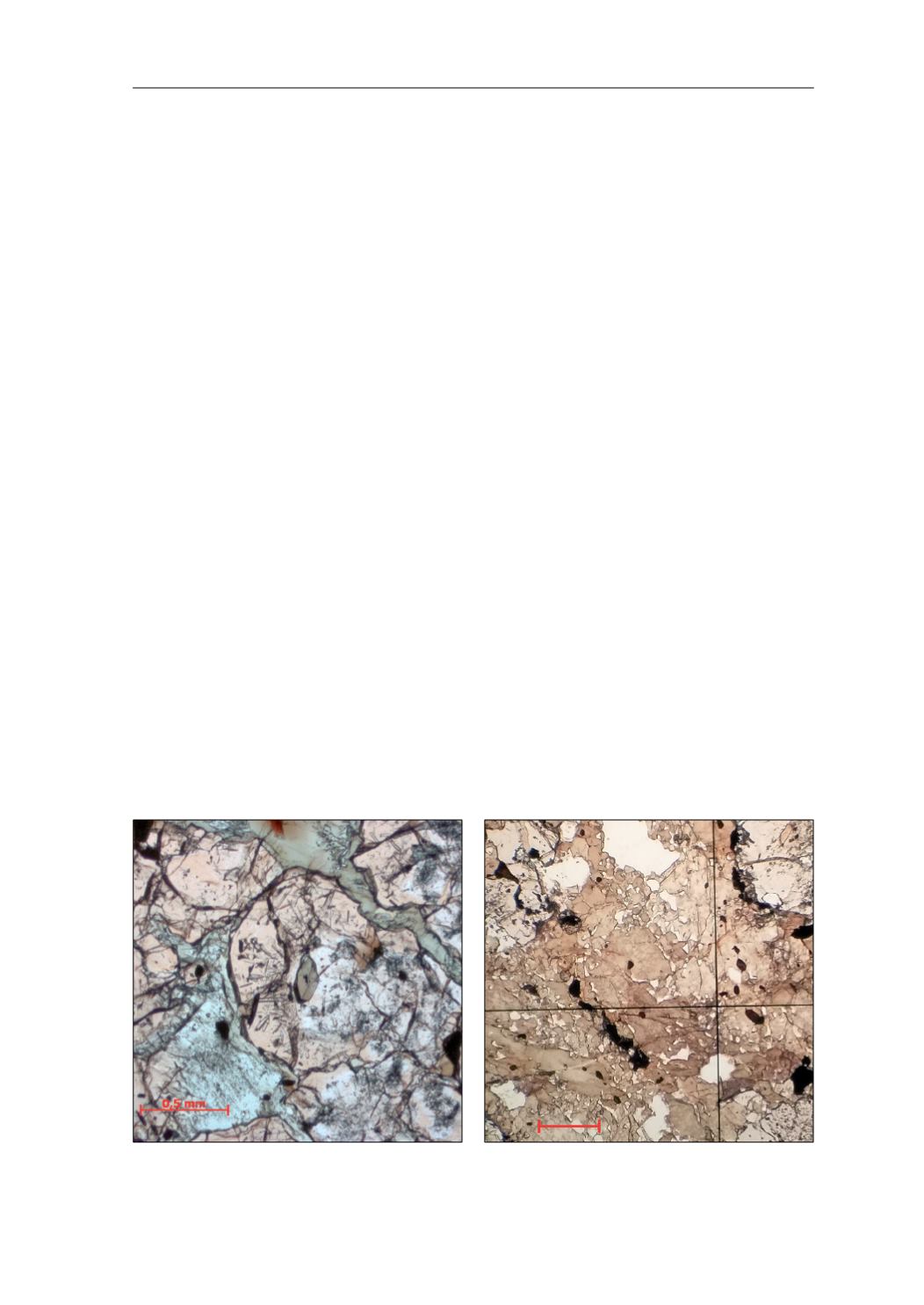
retrograded sample collected in this area (Fig.
29; Ref: 112682) has a porphyro-nematoblastic
texture and has abundant poikilitic Grt, which
have colourless “dusty” cores with abundant
inclusions (mainly Ap and Rt) and pink rims
with less inclusions. This eclogite conserves
its primary eclogitic Cpx that show exsolution
lamellas and replacement of their crystal borders
to weak pleochroic green Amp, with almost no
development of symplectites. From a SEM study
it can be approached that these Cpx are calcic,
with a low Na content and that the exsolution
lamellas are also Px, but with less Ca, same Na,
and more Mg, Al, Fe and SiO
2
contents. Other
minerals identified are Qz, Zo, Rt, Ilm, Spn, Ap,
Zrn and relatively big patches of poikilitic non-
oriented brown mica.
The sample gathered for isotopic experiments
out of which results are presented in this section,
is a retrograded eclogite compared with the
above-mentioned specimen. It is a fine tomedium
grained rock with oriented porphyro-grano-
nematoblastic texture (Ref: 113163). Its major
constituents are Grt and Amp (most probably
Hbl) and its minor constituents are Qz, Ap, Rt,
Spn, Ilm, brown mica (very scarce) and Zrn (Fig.
30). Grt are subidioblastic to xenoblastic due to
corrosion and mineral replacements. They are
light pink and poikilitic, with many inclusions
(mainly Qz, Rt, and Amp). Amp has a light
beige-greenish colour, it is non-pleochroic (or
very weakly pleochroic) and shows a moderate to
a very high birefringence. They are displayed as
small crystals within the matrix together with Qz,
Ap, Rt, Ilm, Spn (and probably Pl), and as coarse,
poikilitic xenoblastic crystals. These bigger Amp
crystals are zoned, with darker borders than their
cores and have inclusions of almost all types of
minerals within this rock (Qz, Grt, Rt, Spn, Ap
and Zrn). They also show exsolution lamellas
which are too small to be identified, and show
a “dirty” aspect which is more prominent in the
centre of the crystals. Qz is relatively abundant
and shows weak undulose extinction. It coexists
with small Amp crystals, forming the matrix,
defining a granoblastic amoeboid texture. Spn,
Rt and Ilm are relatively abundant.
Fig. 29.
Photomicrograph of the less retrograded sample.
Fig. 30.
Photomicrograph of the studied sample.
ȝP
7.3. ECLOGITES