


 176 / 352

160
highly improbable.
Zircon with igneous protolith ages (
i.e.
482–473 Ma) and the zircon group with ages
around 444 Ma, correspond to domain I. Lu–
Hf analyses of zircon corresponding to this
domain (19 concordant analyses) yielded
identical
176
Hf/
177
Hf
(t)
within error of 0.282461 ±
0.000019 (±2 SD; Fig. 41b), indicating that these
zircon grains were formed from a isotopically
homogeneous source. This suggests that domain
I zircon in this eclogite crystallised during a
single magmatic event at
c.
482–473 Ma. It also
seems to suggest that the magmatic event lasted
until
c.
444 Ma, but this would imply a
c.
40 Ma
duration, and a timespan this long for an igneous
crystallisation event is not plausible. A possible
explanation (which cannot be supported with
the presented data) is that a metamorphic
event perhaps took place at around 444 Ma or
at 395 Ma, triggering a pseudomorphic zircon
alteration process without a fluid phase.
Lu–Hf analyses of zircon corresponding to
domain II (4 concordant analyses out of which
2 were analysed for Lu–Hf isotopes) yielded
identical
176
Hf/
177
Hf
(t)
within error of 0.282618 ±
0.000001 (±2 SD; Fig. 41b), showing significantly
higher
176
Hf/
177
Hf
(t)
ratios than domain I zircon.
This implies that the Lu–Hf isotopic system
was disturbed during the
c.
395 Ma zircon
crystallisation event. If the rock system did not
remain closed this disruption could be due to
mixing with external sources with a different
Lu–Hf composition. Taking into account that
no veins or leucosomes are found in this eclogite
it is assumed that the rock system remained
closed. If this is true, the higher
176
Hf/
177
Hf
(t)
requires that domain II incorporated additional
radiogenic hafnium (
176
Hf) at its formation.
This
176
Hf comes from
176
Lu decay. Much of the
176
Lu remained in the matrix when the protolith
$
ڙ
$
ڙ
$
ڙ
$
ڙ
ȝP
$
ڙ
$
1R GDWD
ڙ
$
1R GDWD
ڙ
$
ڙ
1R GDWD
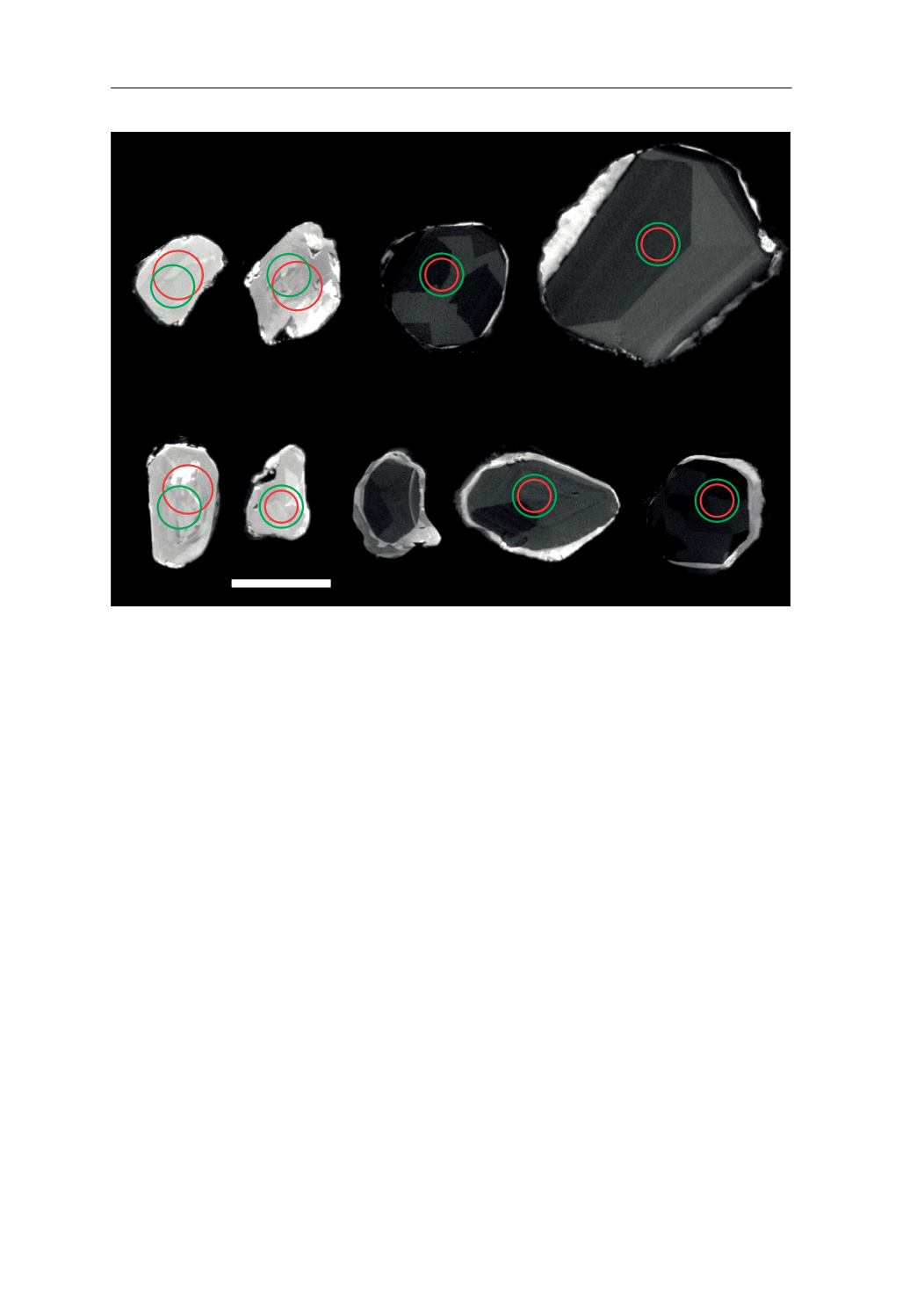
Fig. 40.
CL (cathodoluminescence) images of representative zircons from the studied sample. Laser ablation pits for U–Pb
analyses (red line circles) have 33 and 50
μ
m diameters. Laser ablation pits for Lu–Hf analyses (green line circles) have 40
μ
m diameters. White numbers are the reference number of the analysis, red numbers are the U–Pb age and its 2
σ
error (Ma)
and the green numbers are the
H
Hf values for the U–Pb age. U–Pb analysis of A444 and A450 gave a discordant ages, and
H
Hf value was calculated for an assumed 395 Ma age.
7.3. ECLOGITES