


 174 / 352

158
7.3.3. Sample GCH-22
(Concepenido eclogite)
This eclogite forms part of the Eclogite Band
formation of the HP–HT Upper Allochthon of
the Cabo Ortegal Complex, and is commonly
named in the literature as the
Concepenido
eclogite, the Ky rich eclogite or the Al–Mg
rich eclogite (Mendía, 2000). This sample is
located in the southern part of the Cabo Ortegal
Eclogite Band formation (Appx. 1; 43°40’41”N,
7°55’57”W).
This type of eclogite outcrops structurally
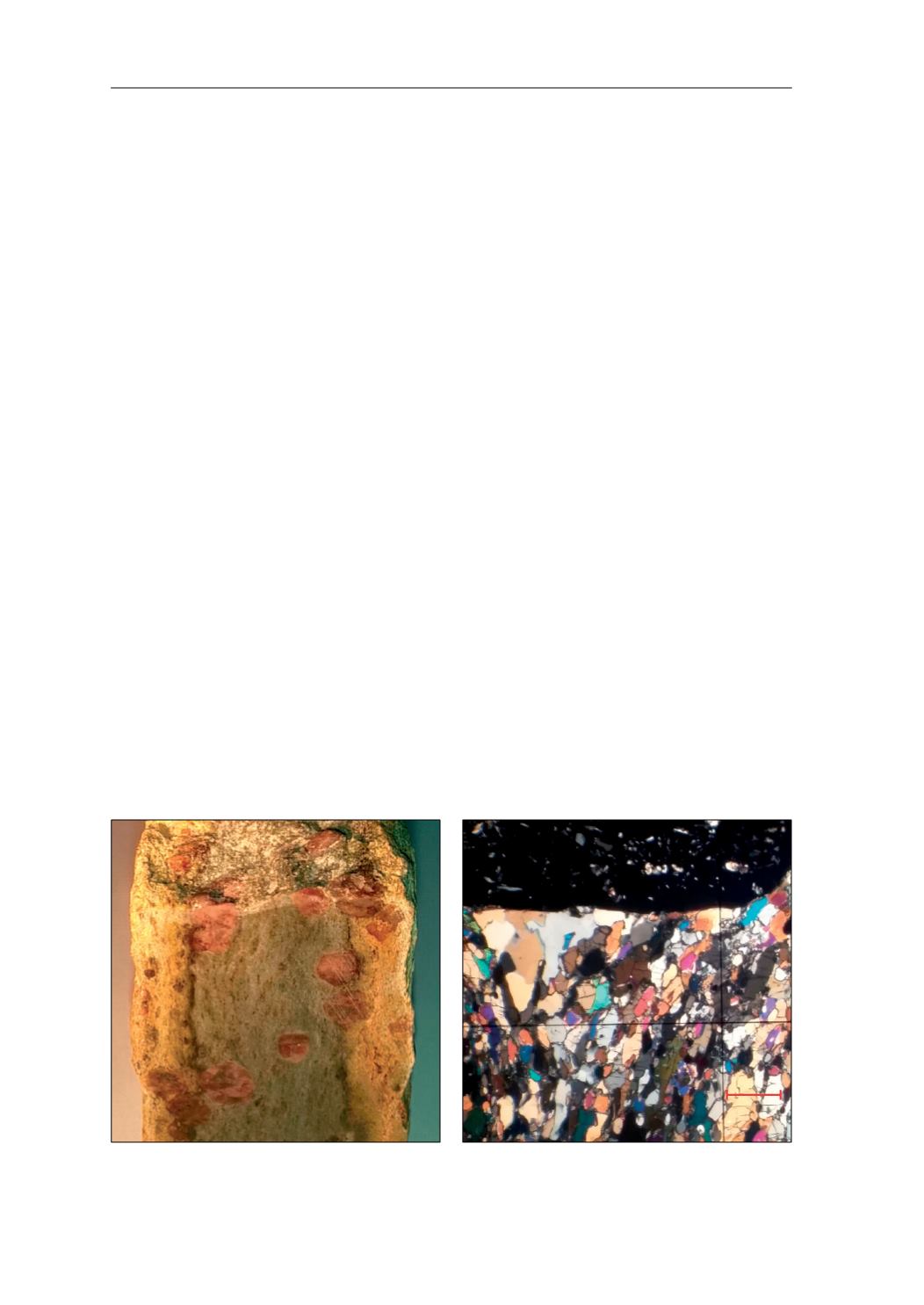
banded. The sample studied is a
c.
3.5
c
m band
with
c.
0.5–1.0
c
m sized garnets (Fig. 36). The 2
c
m inner band has a foliated green-bluish colour
matrix with Px and Ky, and the outer parts have a
brownish matrix, which is probably very altered
due to deformation. Both parts show idioblastic
0.5–1.0
c
m sized garnets. These outer parts were
removed before geochronology experiments
(Ref: 113165).
This sample is amedium to coarse grained rock
with oriented porphyro-grano-nematoblastic
texture. Its major constituents are Grt, Cpx, Ky
and Amp (most probably Hbl) and its minor
constituents are Qz, Rt, Ap, Zo, white mica and
Zrn (Fig. 37). Grt is abundant, idioblastic to
subidioblastic, generally colourless to light pink,
and of millimetre or even centimetre-size. It is
poikilitic with Qz, Zo and Amp rich cores (other
inclusions are Cpx, Ky, Rt, Ap and Opq). It has
been described that needle-shaped inclusions
of Rt in Grt could outline previous igneous Ti–
Aug or Spn (Gil Ibarguchi
et al.
, 1990). Cpx is
relatively abundant and forms elongated crystals
and ribbons. It is also present as poikilitic crystals
with Ky, Qz or Zo inclusions. Other than a small
and non-important presence of symplectites at
the rims of Cpx, no other textures formed by
retrogression were found, and so this Cpx is most
probably Omp. Ky is abundant, present as small
sub-rounded to elongated crystals generally
coherent with the foliation trend. Amp is sub-
idiomorphic and is in net contact with the rest
of the matrix forming minerals. White mica is
poikilitic and also shows net contacts with matrix
forming minerals.
7.3.3.1. Results
From this sample (GCH-22), 82U–Pb analyses
were performed of which 76 were concordant (
d
= 7.3%; Figs. 38 & 39). The U–Pb ages show a
maximum abundance at 473 (domain I) and
relative abundances at 482, 444 (domain I) and
395 Ma (domain II; Fig. 39a).
Most of the zircon grains in this sample
conserve a sector zoning (domain I), which is
interpreted as a primary igneous texture. These
Fig. 36.
Hand specimen photograph of the studied sample.
The specimen is
c
. 3.5 cm wide.
Fig. 37.
Cross-polarized light photomicrograph of the
studied sample.
ȝP
7.3. ECLOGITES