


 196 / 352

180
fragile deformation, or to an interstitial growth
or to a different geological environment for this
sample. An immature sedimentary origin could
explain the fragmentation of the zircon grains,
but this possibility is highly unlikely due to field
and microscopic observations that classify this
rock as having an igneous origin (see Figs. 64
& 65). The high number of inclusions viewed in
BSE images is likely due to have been captured
during zircon growth rather than to be a result
of zircon impurity exsolution due to solid-state
recrystallisation.
$
ڙ
$
ڙ
$
ڙ
$
ڙ
$
ڙ
$
ڙ
$
ڙ
$
ڙ
$
ڙ
$
ڙ
ȝP
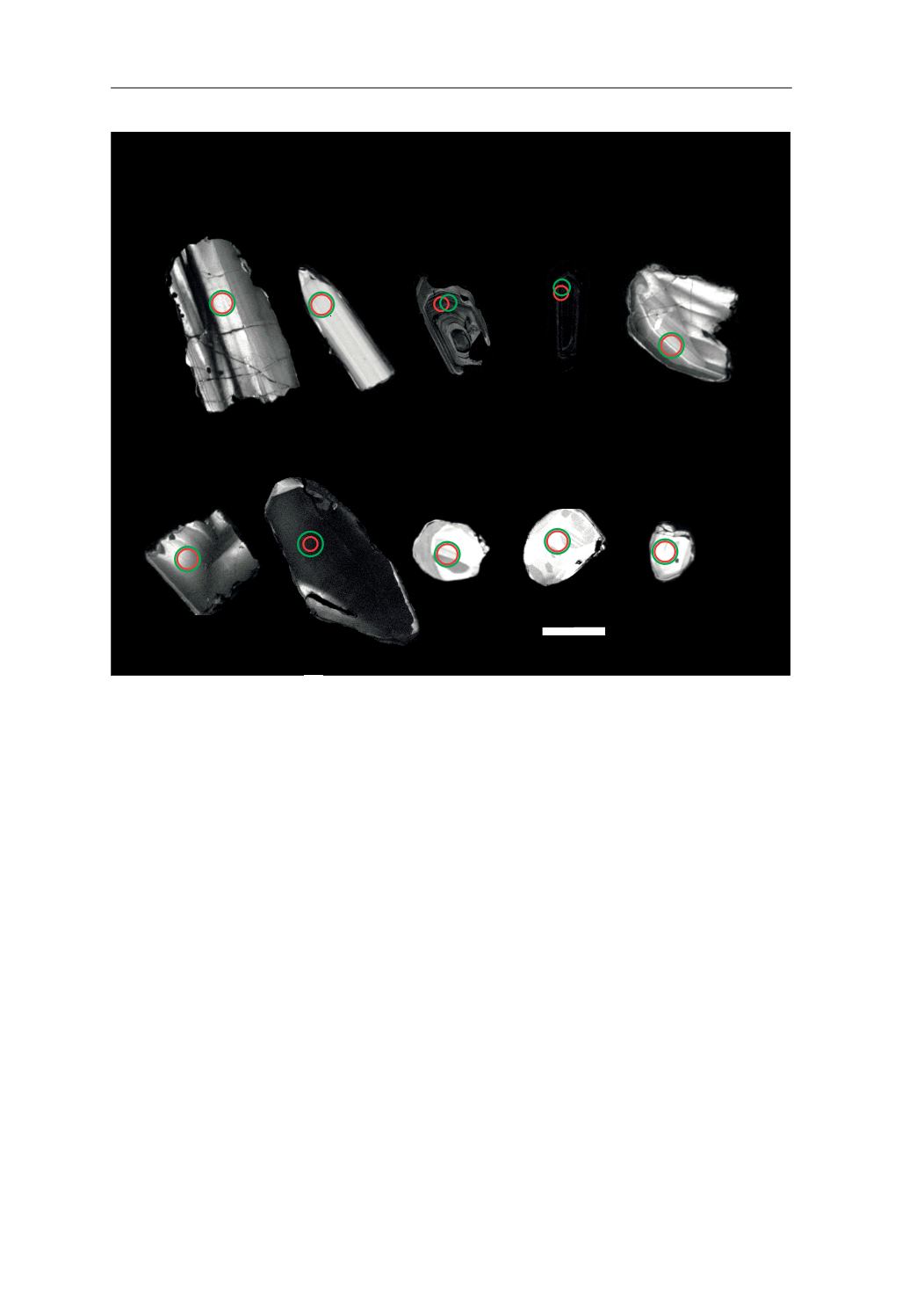
Fig. 68.
CL images (cathodoluminescence) of representative zircons from the studied sample. Laser ablation pits for U–Pb
analyses (red line circles) have 23 and 33
μ
m diameters. Laser ablation pits for Lu–Hf analyses (green line circles) have 26
and 40
μ
m diameters. White numbers are the reference number of the analysis, red numbers are the U–Pb age and its 2
σ
error (Ma) and the green numbers are the
H
Hf values for the U–Pb age.
7.4. ORTHOGNEISSES