


 116 / 352

5. PROVENANCE OF THE UPPER ALLOCHTHON
100
maximum abundance at c. 525 Ma. These ages coincide with the report-
ed ages for the Cadomian and Pan-African orogenies (c. 750
–
540 Ma;
e.g.
Ennih and Liégeois, 2008; Linnemann et al., 2014
) but the c.
525 Ma Cariño Gneiss maximum is younger, suggesting a different
metacratonic WAC activity or a late development of the Cadomian
–
Pan-African orogenies. Paleozoic
–
Neoproterozoic populations in the
WAC are very common. For example, merged samples published by
Abati et al. (2012)
from the Sirwa Window (Anti-Atlas belt) have an
age range of c. 540
–
770 Ma with peaks at c. 560 and 610 Ma.
Thomas
et al. (2002)
reported igneous rock zircon U
–
Pb ages from the same
area with ages of c. 560
–
580, 610 and 740 Ma, and from the NE
fl
ank
of the Zenaga inlier (Anti-Atlas belt) two groups of detrital U
–
Pb ages
where published by
Avigad et al. (2012)
. Ages in these samples were
c. 532
–
668 Ma with a peak at 570 Ma and c. 545
–
750 Ma with a peak
at 655 Ma (in addition to Cryogenian and Tonian peaks). Cariño Gneiss
zircons with ages between c. 760 and 560 Ma are not abundant and plot
in the Lu
–
Hf diagram (
Fig. 8
a and b) around the CHUR evolution trend,
pointing to a crustal recycling of early Cadomian
–
Pan-African material.
C. 560
–
500 Ma Cariño Gneiss zircons are very abundant with a maxi-
mum peak at c. 525 Ma. The Lu
–
Hf isotopic pattern (
Fig. 8
a and
b) shows that these Cariño Gneiss zircons are arranged as a cluster
with positive
ε
Hf values plotting near the DM evolution trend and as a
variably negative
ε
Hf arrangement. These patterns can be explained
by the intrusion of juvenile magmas that triggered mixing process
with an Eburnean and Archean crust and with a small proportion of
reworked early Cadomian
–
Pan-African crustal material, consistent
with a peripheral arc activity at the Northern WAC.
Asdiscussed by
Cawoodet al. (2012)
convergentmargin basinshave
a high proportion of detrital zircons with ages close to the age of the
sediment, where back arc basins have an increasing input of older detri-
tus from the adjoining mainland. The Cariño Gneiss U
–
Pb age distribu-
tion pattern is a strongly bimodal one where the majority of the
Paleozoic
–
Neoproterozoic fraction is concentrated near its MDA, as ap-
preciated by the steep slope of the CDF diagram (
Fig. 5
b), or the narrow
bell shaped curve of the KDE plot (
Fig. 4
). These observations suggest
that the Cariño Gneisses turbiditic greywacke sediments were deposit-
ed in a relatively narrow back-arc type basin, where the late/post
Cadomian
–
Pan-African volcanic arc system was very active, shedding
its juvenile materials into the basin at the same time as the adjacent
WAC furnished the Eburnean and Archean detritus.
Comparison with the Órdenes Complex uppermost unit reveals that
the IP Upper Allochthon is heterogeneous. This unit, which was thought
to correlate with the Cariño Gneiss unit, has yielded a MDA of 510
–
530 Ma and was intruded by a swarm of dykes with protolith ages of
Table 1
Whole rock Nd isotope data of the Cariño Gneiss samples.
Sample
Sm
Nd
147
Sm/
144
Nd
143
Nd/
144
Nd
(o)
2SE(abs)*10
−
6
ε
Nd
(t = 0)
ε
Nd
(t = 510)
T
DM
GCH-07
2.99
16.27
0.1111
0.511841
3
-15.5
-10.0
1783
GCH-08
3.44
18.51
0.1124
0.511879
3
-14.8
-9.3
1751
GCH-09
3.24
17.40
0.1126
0.511876
3
-14.9
-9.4
1758
GCH-10
2.50
13.09
0.1155
0.511869
2
-15.0
-9.7
1821
GCH-11
3.26
18.57
0.1063
0.511856
3
-15.3
-9.4
1683
GCH-12
4.68
24.78
0.1142
0.511968
2
-13.1
-7.7
1645
GCH-27
7.20
36.68
0.1187
0.512054
2
-11.4
-6.3
1584
GCH-28
2.23
11.96
0.1126
0.511834
3
-15.7
-10.2
1821
GCH-29
5.48
27.90
0.1186
0.511962
3
-13.2
-8.1
1731
GCH-30
2.96
16.65
0.1073
0.511815
2
-16.0
-10.2
1757
Average
1733
-20
-15
-10
-5
0
5
10
15
5
0
00
1000
1500
2000
2500
ε
Nd(t)
Age[Ma]
T = 683 - 1205
DM
n = 20
T =
1585 - 1822
DM
n = 10
CHUR
MORB
DM
Max Dep
Ages
Cariño Gneisses,
uppermost greywackes of
the Cabo Ortegal Complex
Uppermost greywackes
of the Órdenes Complex
(Fuenlabrada et al.2010)
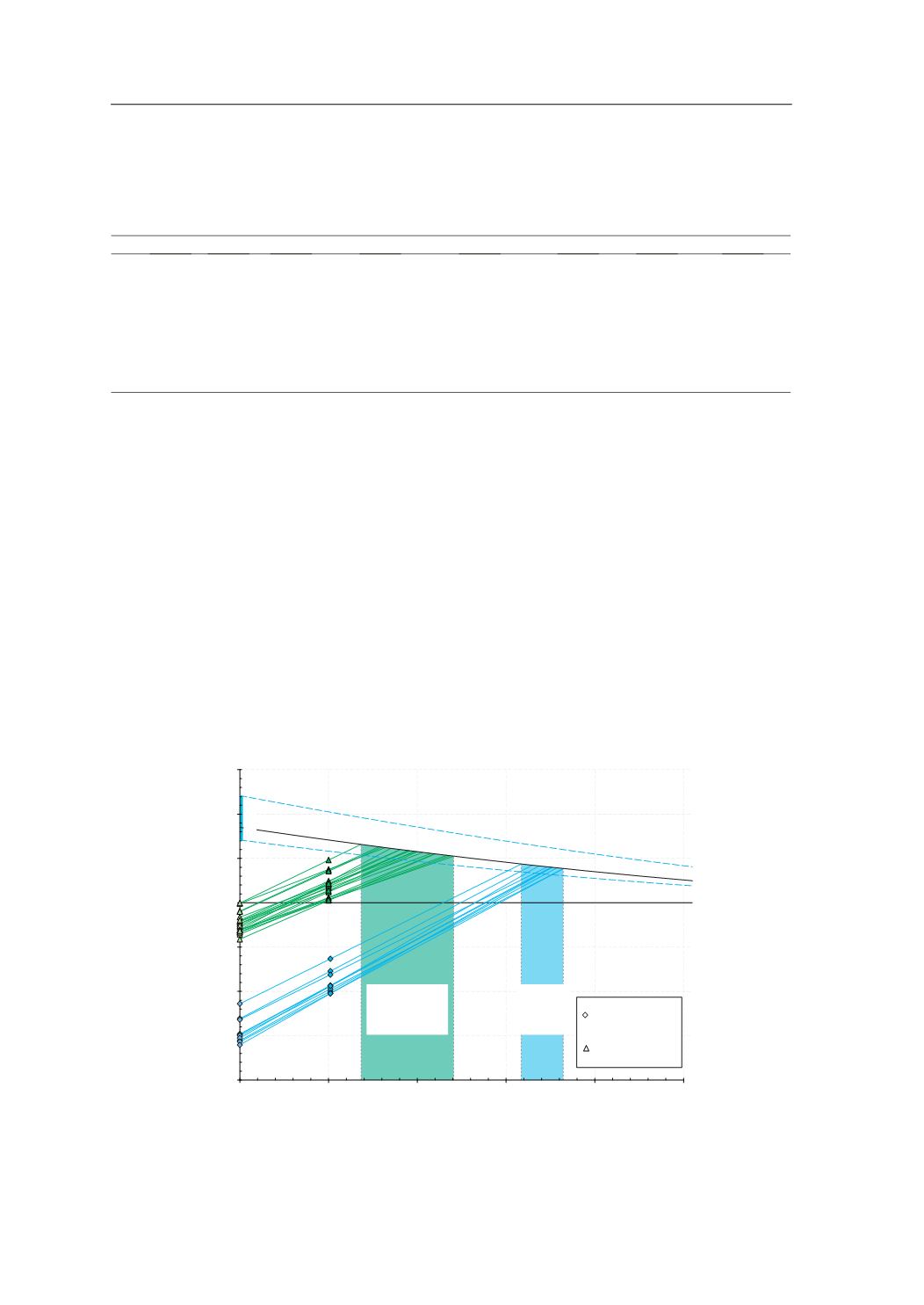
Fig. 9.
Sm
–
Nd isotope evolution diagram showing whole-rock data of 10 metasedimentary rock samples from the Cariño Gneiss formation (Cabo Ortegal Complex, NW Iberian Massif).
Whole-rock Sm
–
Nd data (n = 20) of the uppermost greywackes of the Órdenes Complex (upper units;
Fuenlabrada et al., 2010
) are included for comparison. Rhombus and triangles
show
ε
Ndvaluesatpresentdayandatmaximumdepositionalages.Seetextfordiscussion(
Section5.3
)andforconstantsandparametersused(
Section4.4
).CHUR
—
chondriticuniform
reservoir; DM
—
depleted mantle; MORB
—
mid-ocean ridge basalt.
1445
R. Albert et al. / Gondwana Research 28 (2015) 1434
–
1448