


 115 / 352

5. PROVENANCE OF THE UPPER ALLOCHTHON
99
Cariño Gneisses, the Mesoproterozoic zircons are scarce and scattered,
constituting 3.6% of the total population and not de
fi
ning a clear maxi-
mum (
Fig. 4
). This population is also present in the Parautochthon
(
Díez Fernández et al., 2012b
) and in the Basal Allochthon (basal
units) of NW Iberia (
Díez Fernández et al., 2010
). These populations
could derive from cratons adjacent to the WAC, i.e. Amazonian, Saharan
or the Arabian
–
Nubian cratons (
Fig. 10
), transported by rivers, wind or
by a tectonic along-strike transport of terranes during Cadomian oro-
genic processes (
Fernández-Suárez et al., 2002; Gutiérrez-Alonso
et al., 2003
), or even from unknown Mesoproterozoic igneous rocks in
the WAC. In any case the Mesoproterozoic population is still enigmatic
but it is present in the siliciclastic derived formations of the allochtho-
nous complexes of NW Iberia, albeit in much lower proportions than
in putative coeval rocks of the Autochthon (
Fernández-Suárez et al.,
2013
and references therein) and it could be a distinctive feature for
these rocks.
The Paleozoic
–
Neoproterozoic fraction constitutes 36% of the Cariño
Gneiss zircons, most of them with ages of c. 750
–
490 Ma and with a
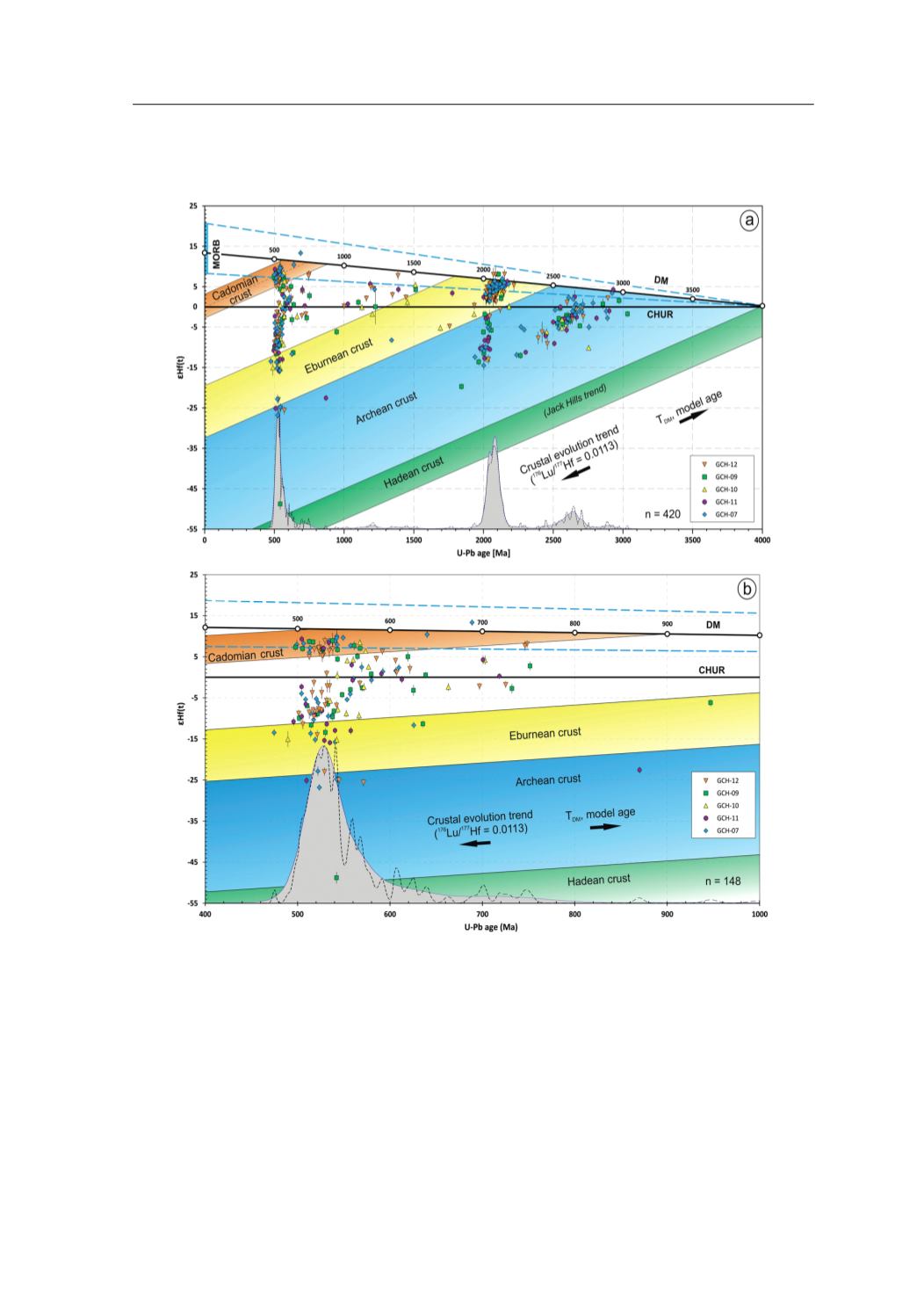
Fig. 8.
(a) Hf isotope evolution diagram showingCariñoGneiss zircon data. Kernel Density Estimation ofanalysed zirconswith Lu
–
Hf systematics isrepresented ingrey. See text for dis-
cussion(
Section5.2
) andfor constants and parametersused(
Section 4.3
). CHUR
—
chondriticuniformreservoir;DM
—
depletedmantle;MORB
—
mid-oceanridgebasalt. (b)Hfisotope
evolution diagram of analysed zircon grains in the age range of 400
–
1000 Ma. See text for discussion, and for constants and parameters used.
1444
R. Albert et al. / Gondwana Research 28 (2015) 1434
–
1448