


 117 / 352

5. PROVENANCE OF THE UPPER ALLOCHTHON
101
c. 510 Ma (
Fernández-Suárez et al., 2003; Díaz García et al., 2010;
Fuenlabrada et al., 2010
). Its zircon population (n = 85) has 81% of
Paleozoic
–
Neoproterozoic zircons, 0% are Mesoproterozoic, 19% are
Paleoproterozoic and 0% are Archean ones. This unit has a higher Paleo-
zoic
–
Neoproterozoic zircon input and younger Nd DM model ages
(TDM
mean
= 1 Ga) than the Cariño Gneisses (TDM
mean
= 1.73 Ga,
Fig. 9
). Therefore the IP Upper Allochthon of the NW Iberian complexes
is interpreted to represent different stages and positions within the
peri-Gondwanan back-arc basin, where the Cariño Gneisses were
deposited closer to the stable metacraton (WAC) and the Órdenes
Complex Upper Allochthon unit was deposited closer to the arc.
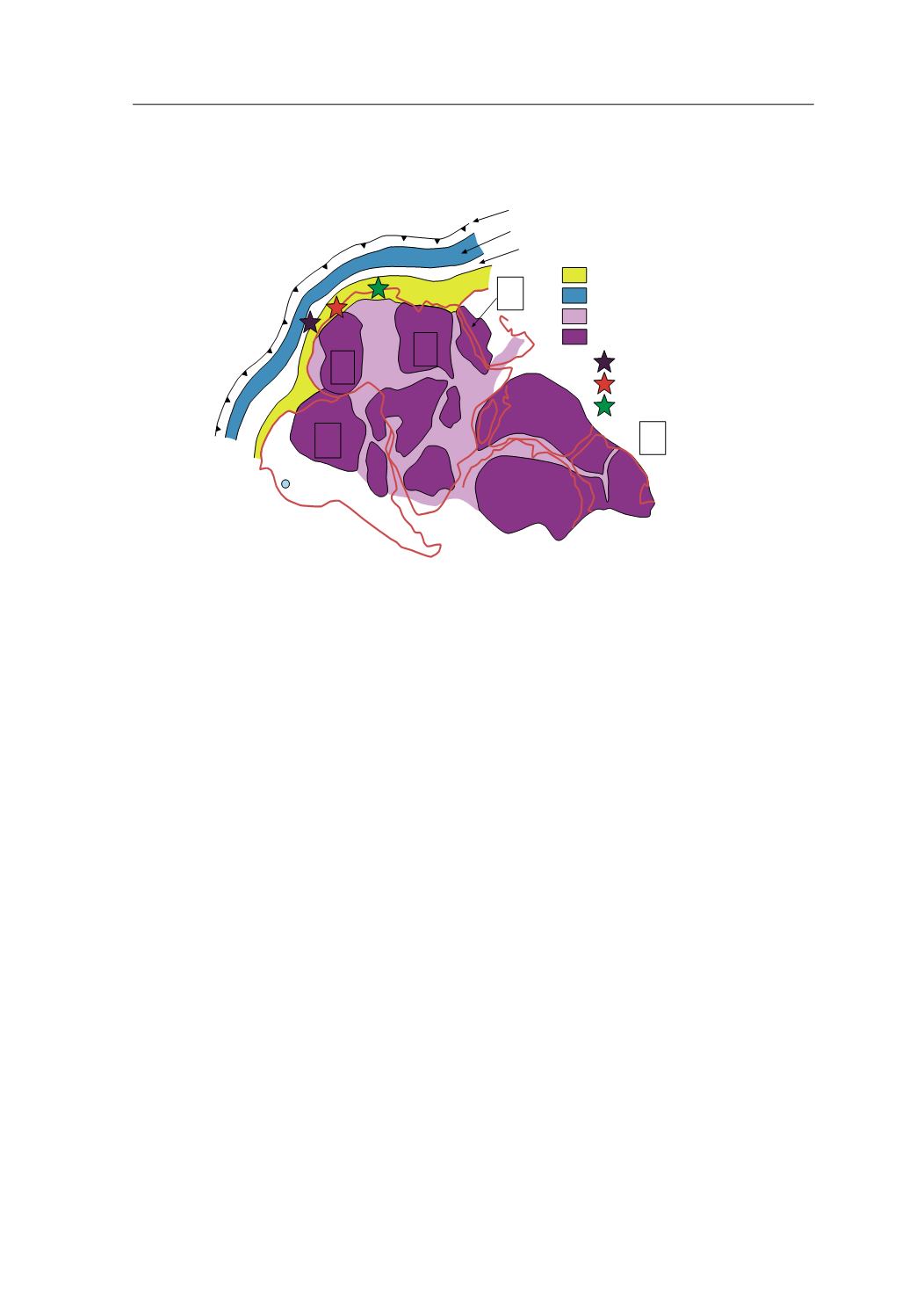
A paleogeographical sketch map of the peri-Gondwanan region at
c. 500 Ma is presented in
Fig. 10
. The sedimentary series included in
the upper units were deposited close to a long lived volcanic arc. The
Cariño Gneiss protoliths were probably formed in a back-arc basin, in
a sedimentary basin with abundant detritus coming from the most
active part of the arc and from the mainland. Other siliciclastic series
from the Upper Allochthon, such as the Órdenes Complex top
metagreywackes, were deposited closer to the active part of the arc, in
a domain of the sedimentary basin where the arc was the main sedi-
ment supplier. The basal units of the allochthonous complexes contain
siliciclastic metagreywacke series with MDA in the range of c. 560
–
517 Ma and detrital zircon maximum abundance age of c. 650 Ma
(
Díez Fernández et al., 2010
). These siliciclastic series are characterized
by Nd TDMmodel ages in the range of 1.74
–
2.22 Ga (
Fuenlabrada et al.,
2012
), the oldest model ages reported so far in the NW Iberian terranes,
including both the autochthonous and allochthonous domains. These
relatively old isotopic sources strongly suggest deposition in a tectonic
setting where detritus were sourced dominantly from the Gondwana
mainland (
Fig. 10
). The most frequent siliciclastic series included in
the basal units (
Díez Fernández et al., 2010
) seems to be older that
those forming part of the Upper Allochthon. They were deposited closer
to the mainland and they do not re
fl
ect the most recent activity of the
arc during the Middle Cambrian. Finally, according to available zircon
data and the dynamic evolution of the Variscan belt, the original setting
of the Iberian Autochthon was probably located further to the East, in
any transitional region between theWest African Craton and the Sahara
Craton (
Fig. 10
;
Gómez Barreiro et al., 2007; Díez Fernández et al., 2010;
Shaw et al., 2014
), or even further East, in the vicinity of the present day
Jordan
–
Israel region (
Fernández-Suárez et al., 2013
).
7. Conclusions
The protoliths of the Cariño Gneiss formation, the intermediate
pressure Upper Allochthon included in the Cabo Ortegal Complex,
are formed by siliciclastic series that represent the deposition of
greywackes by turbidity currents at c. 510 Ma (maximum depositional
age from detrital zircons). Considering the high proportion of Eburnean
zircon input and its relatively old whole rock Nd TDM values, the
siliciclastic series were deposited in a peripheral back-arc basin some-
where between an active volcanic arc and the Northern margin of the
West Africa Craton (WAC). In this tectonic setting, detritus arrived
both from the active part of the volcanic arc and from the mainland.
These metasedimentary rocks record Archean, Eburnean, and late or
post-Cadomian
–
Pan-African crust formation events, with a 3.6%
Mesoproterozoic zircon input.
In the source region of the gneiss formation, the Archean crust for-
mation event is roughly dated at c. 3.3
–
2.9 Ga, which is represented
by zircons with c. 3.0
–
2.2 Ga crystallization ages. These Archean
materials suffered important crustal reworking processes supporting
an intracratonic or an active margin setting.
The recorded Eburnean events represent the intrusion of Eburnean
juvenilemagmas into anArcheanbasement, mostprobably theArchean
basement represented by the Cariño Gneiss Archean zircons. The most
probable geodynamic setting is a volcanic arc at the margin of a pre-
existing Archean craton.
Archean and Paleoproterozoic (Eburnean) zircon populations seem
to be derived from the WAC. The Cambrian events recorded in the
Cariño Gneisses represent a magmatic arc at the periphery of the
North Gondwana margin, speci
fi
cally the North WAC. This arc records
the intrusion of c. 525 Ma juvenile magmas into the Eburnean and
Archean basement of Gondwana. The
fi
rst stages of the arc were proba-
bly linked to the Cadomian arc system, de
fi
ned in other parts of Europe
Long lived magmatic arc
(c. 750-500 Ma)
Ediacaran - Cambrian
peri-Gondwanan series
Neoproterozoic orogens
Cratons and meta-cratons
Active long lived subduction zone
Back-arc basin
c. 500 Ma
Avalonian - Cadomian Magmatic Arc
0.54-1.1
1.8-2.2
2.7-2.9
3.1-3.4
Ga
0.54-1.2
1.6-2.3
2.6-2.8
3.0-3.3
Ga
0.54-0.7
1.0-1.35
1.45-1.75
2.5-3.1
Ga
0.55-0.65
0.74-1.1
1.65-1.85
2.45-2.7
Ga
0.55-0.65
0.74-1.1
1.65-1.85
2.45-2.7
Ga
Zircon ages from
the cratons
Upper units in NW Iberia
Basal units in NW Iberia
Autochthon in NW Iberia
Amazonian
Craton
West
African
Craton
Sahara
Meta-Craton
Congo
Craton
Kalahari
Craton
Arabian
Nubian
Shield
Indian
Shield
EastAntartic
Shield
Australian
Shield
Iapetus - Tornquist Ocean
South Pole
Fig. 10.
Sketchshowingtheproposedpaleogeographic position oftheupper units and otherterranes from theNW Iberian Massif. Paleogeographical context basedon
Fernández-Suárez
etal.(2013)
.NumbersinsquaresarezirconagesinGafromthecratons,from
Linnemannetal.(2014)
andreferencestherein.NewzirconageshavebeenaddedtotheWestAfricanCraton
(
Avigad et al., 2012
) and to the Arabian Nubian Shield (
Morag et al., 2012
).
1446
R. Albert et al. / Gondwana Research 28 (2015) 1434
–
1448