


 206 / 352

190
7.4.6. Sample GCH-31
(Serrón orthogneiss)
This sample was collected from
Punta do
Serrón
,
Area da Vaca
beach (43°43’35.8”N,
7°51’49.5”W), at the 490 m point of the
Area da
Vaca
geological section (chapter 4).
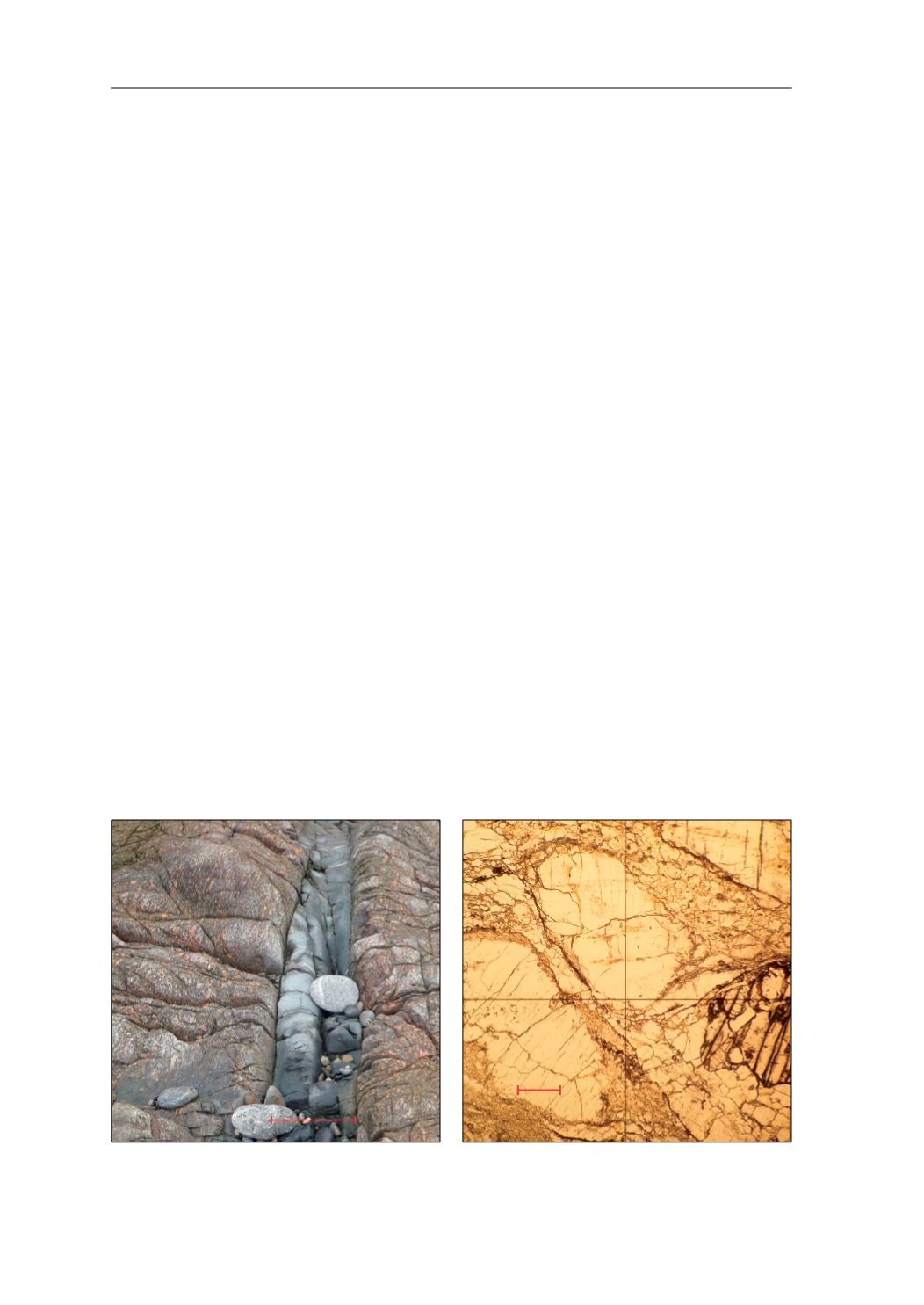
This orthogneiss outcrops as a porphyritic
felsic rock with reddish feldspar centimetre
porphyroblasts within a melanocratic matrix.
It outcrops in contact with a mafic rock (
Punta
do Serrón
mafic rock, meter point 460,
Area da
Vaca
geological section; chapter 4). From field
observations this mafic rock seems to intrude
this orthogneiss (Fig. 85).
From microscopic observations this sample
has a porphyro-grano-lepidoblastic texture (Ref:
114094).Qz,GrtandAfsarethemajorconstituents
(Fig. 86). Qz is displayed as small matrix-forming
crystals in a granoblastic polygonal texture and
they are mainly disposed in the porphyroblasts
pressure shadows together with Bt, Ap and Grt.
Qz is also displayed as tabular elongated poly-
crystals coherent with the foliation. Grt and Afs
are displayed as porphyroblasts and as small
crystals within the matrix. Afs porphyroblasts
normally show microcline twinning and they are
normally poikilitic, containing mainly Qz and
Afs crystals. In other cases this poikilitic texture
seems to be a porphyroclastic texture, where the
porphyroblasts are crushed or fragmented. The
microcline twinning of these porphyroblasts
seems to be an over-imposed feature, because it
is not evident in all the crystals and in some cases
it seems more evident at their outer parts. Other
constituents are Bt, white mica, Ap and Zrn. Bt
together with Qz tabular poly-crystals define the
foliation.
7.4.6.1. Results
From this sample (GCH-31), 64 U–Pb
analyses were performed of which 47 were
concordant (
d
= 26.5%; Figs. 87 & 88). The U–Pb
ages are scattered in the range of
c
. 470 to 520
Ma, with a maximum abundance peak at 483 Ma
(Fig. 88) and two relative abundance peaks at 498
and 512. There are also two concordant zircon
inheritances with ages of 635 and 2140 Ma.
Zircon is usually idiomorphic and shows
a generally well-defined oscillatory growth
pattern. In some cases this texture is blurred and
faded. The majority of the zircon grains show
rims which are darker than their cores in CL
images. The contacts between cores and rims are
usually sinuous and transgressive (Fig. 89).
H
Hf
(t)
values for all Cambrian zircon grains
analysed are negative with an average value of
-4.1 (minimum: -28.4, maximum: -0.1; Fig. 90a).
a FP
Fig. 85.
Field photograph of the studied sample.
Fig. 86.
Phtomicrograph of the studied sample.
ȝP
7.4. ORTHOGNEISSES